

How to Evaluate B2B Data Vendors for Accuracy and Compliance
Software buyers do most of their homework before they ever talk to a salesperson. They read comparison pages, lurk in communities, watch demos on their own time, and arrive at the first sales call already 60–70% of the way through their decision. That shift has a hard consequence for growth teams: if your pipeline depends on a single acquisition channel, a single algorithm update, or rising ad costs, it can quietly starve it.
B2B SaaS lead generation is the discipline of building a repeatable system that attracts, qualifies, and converts the right accounts across multiple channels—so growth becomes predictable instead of accidental. This guide focuses on the strategy behind that system: how the funnel works, which channels earn quality leads, and how to optimize for revenue rather than raw volume.
SaaS sells a subscription, not a one-time transaction. That changes the economics of every lead. You aren’t just closing a deal—you’re acquiring a relationship that has to be retained and expanded for months before it becomes profitable.
SaaS buyers rarely move in a straight line. They research a problem, compare competing tools, evaluate through trials and demos, and purchase only after building internal consensus. Much of this happens in “dark” channels you can’t track—Slack groups, peer referrals, private review sites. Your job in SaaS demand generation is to be present and credible at each of these moments, not just at the point of conversion.
Several structural challenges make SaaS customer acquisition harder than typical B2B selling:
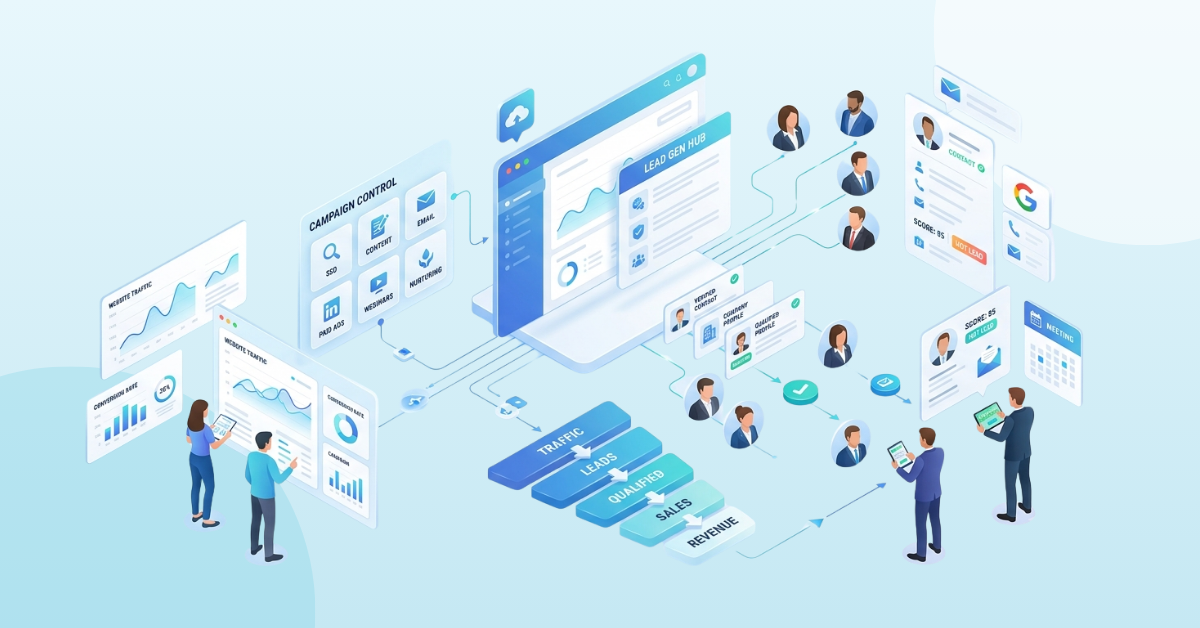
A healthy SaaS sales funnel maps to how buyers actually move—from unaware to evaluating to committed.
Prospects first discover you while searching for a solution to a problem, not for your brand. Inbound marketing—SEO articles, comparison guides, thought leadership, and community presence—captures this early demand and plants your name before competitors do.
Now they’re actively comparing options. This is where product comparisons, case studies, on-demand demos, webinars, and third-party reviews do the heavy lifting. Content here should answer “why you over the alternatives?” with proof, not adjectives.
At the bottom, buyers want to reduce risk. Free trials, transparent pricing pages, ROI calculators, and well-run sales conversations give them the confidence to commit and the internal ammunition to win budget approval.
Not every channel serves the same purpose. Grouping them by intent helps you invest where each one performs best.
SEO, content marketing, product-led content, and high-converting landing pages compound over time. Product-led growth—letting the product itself generate signups through free tiers or interactive tools—produces some of the highest-intent leads because users have already experienced value. These channels are slower to start but deliver the lowest long-term cost per lead.
Cold email, LinkedIn outreach, sales prospecting, and account-based marketing let you target specific accounts rather than wait for them. Outbound prospecting works best when you’re pursuing well-defined, high-value segments and need a pipeline faster than organic can supply. ABM is ideal for enterprise deals where a handful of accounts justify concentrated effort.
Google Ads capture active demand; LinkedIn Ads reach precise job titles; retargeting recovers visitors who didn’t convert; sponsored newsletters build awareness in niche audiences. Paid channels perform best for testing messaging quickly and filling gaps while organic matures—but they stop the moment you stop paying.
lead with organic and product-led content for a durable, low-cost pipeline; layer in outbound and ABM for targeted, high-value accounts; use paid to accelerate and experiment.
More leads rarely fix a weak pipeline. Better-fit leads do. Sharper targeting lifts conversion rates and keeps your sales team from burning hours on prospects who will never buy.
Define the firmographics, technographics, and pain points of accounts that buy fast, stay long, and expand. Your ICP becomes the filter for every campaign in your B2B SaaS marketing engine.
Signals like pricing-page visits, competitor comparisons, demo requests, or third-party intent data reveal who is actually in-market—so you prioritize the 5% ready to talk over the 95% just browsing.
Reference the prospect’s industry, role, and specific challenge. Personalized, relevant outreach consistently outperforms volume-based blasting and protects your sender reputation.
You can’t optimize what you don’t measure. Track both the top-of-funnel activity and the revenue it produces.
Website visitors, MQLs (marketing-qualified leads), SQLs (sales-qualified leads), and demo requests tell you whether the funnel is filling and where prospects stall.
CAC, LTV, conversion rate, pipeline value, and revenue attribution tell you whether that activity is actually profitable and which channels deserve more budget.
Most stalled pipelines trace back to a few avoidable errors.
A single-channel engine is fragile.
Fix: diversify across organic, outbound, and paid so no one disruption can sink the pipeline.
Passing every signup to sales wastes rep time and inflates CAC.
Fix: implement scoring and clear MQL/SQL definitions.
When teams disagree on what a “good lead” is, handoffs break.
Fix: agree on a shared ICP, definitions, and an SLA for follow-up.
Speed and persistence win deals; most leads need multiple touches.
Fix: automate immediate responses and sequence structured follow-ups.
Chasing vanity metrics like raw traffic hides real performance.
Fix: anchor reporting to pipeline, CAC, and revenue.
Strategy only works when you can reach the right people. That’s where accurate contact data becomes the foundation of every outbound and ABM motion.
ReachStream helps SaaS teams identify verified decision-maker contacts, enrich company and firmographic data, and build targeted prospect lists that match their ICP. Instead of guessing which accounts to pursue, teams can filter by industry, role, company size, and other attributes—then feed clean, deliverable data straight into outbound campaigns and CRM workflows. The result is less time cleaning lists and more time engaging accounts that fit, which directly improves lead quality and reduces wasted sales effort.
Predictable growth doesn’t come from one clever tactic. It comes from combining multiple acquisition channels, measuring the metrics that map to revenue, and continuously optimizing the funnel based on what the data shows. Start with a sharp ICP, build durable organic demand, layer in targeted outbound and paid, and qualify rigorously so your team spends time only on leads that convert. For broader frameworks that connect these pieces across your entire go-to-market, explore The Ultimate B2B Lead Generation Guide.
It’s the process of attracting, qualifying, and converting businesses into prospects for a subscription software product, using a mix of inbound marketing, outbound prospecting, and paid channels built around an ideal customer profile.
There’s no single best channel. Organic and product-led content deliver the lowest long-term cost, outbound and ABM win high-value accounts, and paid ads accelerate testing. A blended approach performs best.
Paid and outbound can generate leads within weeks, while SEO and content marketing typically take 6–12 months to compound. Most sustainable engines combine quick wins with long-term investments.
It varies widely by model and channel, but free-trial-to-paid conversions often land in the low single- to low double-digit range, and MQL-to-SQL rates commonly fall between 10–30%. Track your own baseline and improve against it.
By scoring leads on fit (how closely they match the ICP) and behavior (engagement and intent signals), then routing only sales-ready leads to reps while nurturing the rest.
CAC, LTV, LTV:CAC ratio, conversion rate, pipeline value, and revenue attribution matter most because they connect marketing activity to profitable growth.
Marketing professional with a Master’s degree in Marketing, specializing in SEO, content strategy, social media, performance marketing, prospecting, and demand generation.
Access 200M+ verified business emails and grow your sales pipeline effortlessly.
Don't forget to share this post!















Check out our other blogs!
ReachStream Prospect vs. Prospeo: Which Delivers More Accurate Data
B2B Data Enrichment: Complete Guide to Enriching Lead Data
The Complete Guide to B2B Data Verification in 2026
ReachStream Prospect Reviews in 2026: What Real Users Say on G2