


How to Evaluate B2B Data Vendors for Accuracy and Compliance

>How to Clean

At some point, every marketing team opens their sending platform to find a bounce rate that makes no sense. The list looked fine a few months ago. Nothing was imported recently. And yet emails bounce, open rates drift down, and a campaign that should have performed well quietly underdelivers. This is what an aging list looks like from the outside, and it is almost always a data problem, not a messaging one.
Learning how to clean an email list is one of the most valuable skills a sales or marketing team can build. It is not glamorous work, but it is the difference between campaigns that reach real inboxes and campaigns that gradually damage your sending domain’s reputation. This guide walks through the exact process, step by step, along with the mistakes to avoid and how to decide between manual effort and an automated tool.
Use ReachStream Email Verifier to run a free check in minutes and identify valid, risky, and invalid addresses before your next campaign.
Every invalid address sitting in a marketing database is a small risk waiting to surface at send time. Mailbox providers like Gmail and Yahoo now weigh sending behavior heavily when deciding whether a message reaches the inbox or the spam folder. A pattern of sending emails to invalid addresses signals exactly the kind of behavior those filters are
designed to catch.
Deliverability practitioners commonly treat a bounce rate above 2 percent as worth investigating, with rates above 5 percent considered high enough to actively damage sender reputation. These are not official platform thresholds, but they reflect widely accepted practice among email marketers.
Use real–time verification on forms and signups, so bad data never enters your database in the first place, and save bulk email cleaning passes for lists that have been sitting for a while or were imported from an outside source.
Finally, suppress anything flagged Do Not Mail, along with addresses that have never opened or clicked after repeated sends. These addresses may be technically valid, but continuing to send to them drags down engagement metrics that inbox providers use to judge sender reputation.
Some smaller teams still clean email lists manually. It works, up to a point. Here is how the two approaches actually compare.
| Factor | Manual Cleaning | Automated Verification |
|---|---|---|
|
Catches typos and formatting errors |
Yes, with careful review |
Yes, instantly |
|
Confirms a mailbox actually exists |
No, not reliably |
Yes, through mailbox level checks |
|
Scales to thousands of addresses |
Slow and error prone |
Built for bulk email cleaning |
|
Best suited for |
Very small, low volume lists |
Marketing campaigns and B2B prospecting at scale |
ReachStream Email Verifier handles the automated side of this comparison. It categorizes email addresses into five statuses: Valid, Invalid, Risky, Unknown, and Do Not Mail. Independent testing reports an accuracy rate of 99.8%, and the platform supports batch uploads of up to 25,000 email addresses at a time. New accounts receive 100 free credits to test the service with a real list.
Tie list cleaning to your campaign calendar rather than leaving it to memory. A quick verification pass scheduled a few days before every major send catches decay before it becomes a bounce rate problem.
Not every verification provider is built the same way. Before choosing one, check how it classifies uncertain results, what its published accuracy figure is, whether its batch limits match your list sizes, and what compliance certifications it holds.
Here are the key features to look for:
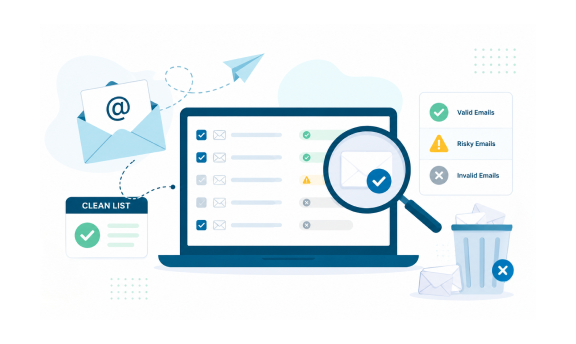
Discover how ReachStream Email Verifier classifies valid, risky, and invalid email addresses to help improve deliverability.
Knowing how to clean an email list is not a one time skill you use once and forget. It is a repeatable process: remove the obvious junk, verify what remains, segment the uncertain results, and suppress what is dragging down engagement. Teams that build this into a regular rhythm consistently protect their sender reputation and get more of their messages into the inbox where they belong.
The fastest way to put this into practice is to run your current list through a real verification pass and see exactly where it stands.
Try ReachStream Email Verifier free and get a clear breakdown of every address on your list.
Yes. Removing invalid addresses lowers your bounce rate, protects your sender reputation, and improves inbox placement. ReachStream Email Verifier offers a 30-day free trial with 100 credits, allowing you to verify your email list and experience the benefits firsthand.
The terms are often used interchangeably. Both describe the process of confirming an address is properly formatted, tied to a real domain, and associated with an active mailbox before it is used in a campaign.
Re-verify any list older than 60 to 90 days before a new send, and always verify new lists in full before their first campaign, since email marketing databases decay continuously.
You can catch obvious typos and duplicates manually, but manual review cannot confirm whether a mailbox actually exists on the receiving server. That level of confirmation requires an automated verification tool.
Yes, when done through a verification platform built for scale such as ReachStream Email Verifier. Batch verification is standard practice for B2B prospecting and marketing campaigns, and it is significantly more reliable than manual review at that volume.
Author

Access 200M+ verified business emails and grow your sales pipeline effortlessly.
Don't forget to share this post!















Check out our other blogs!
The Complete Guide to B2B Data Verification in 2026

Cold Email vs. LinkedIn Outreach: Which Wins in 2026?
How Many Follow-Ups Should a Cold Email Sequence Have?

ReachStream Prospect vs. Prospeo: Which Delivers More Accurate Data