


How to Evaluate B2B Data Vendors for Accuracy and Compliance
Building a predictable sales pipeline has become increasingly challenging for B2B organizations. Buyers spend more time researching solutions independently, involve multiple stakeholders in purchasing decisions, and expect personalized interactions before engaging with a sales representative. These changes have made lead generation more resource-intensive, requiring dedicated prospecting efforts, reliable business data, and consistent follow-up across multiple channels.
While many organizations invest in internal sales development teams, maintaining a steady flow of qualified leads often demands significant investments in recruitment, training, technology, and data management. For growing businesses, this can slow expansion and place additional pressure on sales teams that are already focused on nurturing opportunities and closing deals.
Outsourced lead generation addresses this challenge by allowing businesses to partner with specialists who manage the early stages of the sales funnel. From identifying target accounts and building prospect lists to executing outreach campaigns and qualifying leads, outsourced providers help organizations create a more efficient pipeline without increasing internal headcount.
The expectations placed on modern B2B sales teams have expanded significantly. Beyond closing deals, sales representatives are often expected to research prospects, build contact lists, send outreach campaigns, schedule meetings, and maintain CRM records. Balancing these responsibilities can reduce the time available for meaningful customer conversations and revenue-generating activities.
At the same time, competition has increased across nearly every industry. Businesses entering new markets or launching new products need qualified prospects quickly, but building an internal prospecting operation requires months of hiring, onboarding, and process development. Outsourced lead generation helps organizations overcome these challenges by providing immediate access to experienced prospecting professionals, established workflows, and scalable resources.
Several operational and strategic factors encourage businesses to outsource lead generation.
In-House Lead Generation | Outsourced Lead Generation |
Requires hiring and training | Ready-to-deploy prospecting specialists |
Higher operational costs | Flexible and scalable engagement |
Limited by internal capacity | Supports larger prospect volumes |
Longer implementation time | Faster campaign launch |
Internal responsibility for data quality | Providers often manage research and verification. |
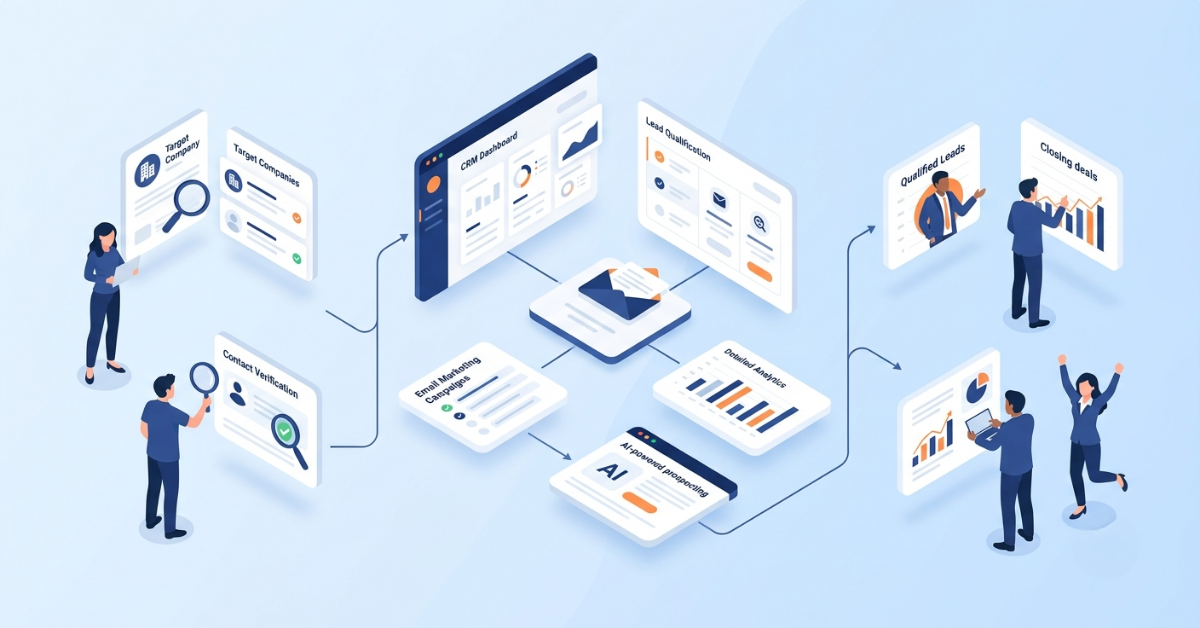
A successful outsourced lead generation program follows a structured process rather than relying on mass outreach. Each stage is designed to improve targeting, increase engagement, and ensure that only qualified prospects reach the sales team.
Although individual providers may use different methodologies, most campaigns follow four essential phases: defining the target audience, building prospect lists, engaging prospects across multiple channels, and qualifying leads before handing them to sales.
When these stages work together, businesses create a repeatable system that delivers consistent opportunities while allowing sales representatives to focus on converting prospects into customers.
Every successful campaign begins with understanding the business itself. Before any outreach starts, providers work closely with clients to understand their products, services, competitive positioning, revenue goals, and target markets.
The next step is creating an Ideal Customer Profile (ICP), which defines the types of organizations most likely to benefit from the company’s solution. Instead of targeting every possible prospect, the campaign focuses on businesses that closely match existing successful customers.
A comprehensive ICP generally includes:
Campaign objectives are also established during this stage. These may include generating qualified meetings, increasing pipeline value, expanding into new markets, or supporting product launches. Clear objectives provide measurable benchmarks throughout the campaign.
Once the ICP has been finalized, providers begin identifying organizations and decision-makers that align with the campaign goals. Rather than collecting large volumes of contacts, emphasis is placed on relevance and data accuracy.
Researchers identify target companies, verify contact information, gather firmographic details, and segment prospects into meaningful groups. This preparation improves campaign personalization and helps outreach remain relevant to each audience.
High-quality prospect lists generally include:
Accurate prospect data reduces bounced emails, improves response rates, and enables more effective sales conversations.
Prospect List Stage | Purpose |
Company Research | Identify organizations matching the ICP. |
Contact Discovery | Find relevant decision-makers |
Data Verification | Validate email addresses and phone numbers |
Segmentation | Organize contacts for personalized campaigns. |
Campaign Preparation | Build outreach-ready prospect lists. |
Modern B2B buyers rarely respond after a single interaction. Successful outsourced lead generation combines multiple communication channels to engage prospects consistently throughout the buying journey.
Email campaigns often serve as the initial touchpoint because they allow businesses to introduce solutions at scale while maintaining personalization. Instead of generic messaging, outreach is customized according to the prospect’s role, industry, and business priorities.
LinkedIn complements email by helping providers establish professional credibility. Connecting with decision-makers, sharing relevant insights, and engaging with company updates create familiarity before sales conversations begin.
Cold calling remains valuable for confirming interest, identifying buying intent, and scheduling discovery meetings. For enterprise accounts, providers frequently combine these activities with Account-Based Marketing (ABM), where outreach focuses on carefully selected high-value organizations rather than broad prospect lists.
By coordinating these channels, businesses create multiple opportunities to engage decision-makers while improving overall campaign performance.
Generating responses is only one part of the process. Before prospects are transferred to the internal sales team, outsourced providers evaluate whether they meet the agreed qualification criteria.
Lead qualification helps sales representatives focus on opportunities that have genuine buying potential instead of spending time on prospects who are not ready to engage.
Providers typically assess:
Stage | Primary Activity | Outcome |
Planning | Define goals and ICP | Target audience identified |
Research | Build and verify prospect lists | Sales-ready database |
Outreach | Email, LinkedIn, calls, ABM | Prospect engagement |
Qualification | Assess buying readiness | Qualified leads |
Sales Handover | Schedule meetings and share insights | Pipeline opportunities |
Timeline | Activity |
Week 1 | Business discovery and ICP development |
Week 2 | Prospect research and contact verification |
Week 3 | Multi-channel outreach begins |
Week 4 | Lead qualification and appointment setting |
Ongoing | Campaign optimization and performance reporting |
The four-step process discussed earlier provides the framework for outsourced lead generation, but achieving consistent results depends on how well that process is executed. Businesses that generate a steady pipeline of qualified opportunities typically share several characteristics: they work with accurate business data, personalize every interaction, maintain regular follow-ups, and align their outsourced provider with internal sales and marketing teams.
Business data forms the foundation of every outsourced lead generation campaign. No matter how effective an outreach strategy is, it cannot deliver meaningful results if emails bounce, phone numbers are outdated, or the contacts do not match the target audience.
Reliable prospect data enables providers to identify organizations that fit the Ideal Customer Profile (ICP) established during the planning stage. Verified contact information, accurate company details, and current job titles allow outreach efforts to reach the right decision-makers at the right time.
After identifying the right prospects, the next priority is delivering communication that reflects their business priorities. Generic sales emails rarely attract attention because decision-makers receive countless promotional messages every week.
Effective outsourced providers personalize outreach by considering the prospect’s role, industry, company size, and potential business challenges. Rather than immediately promoting a product or service, they focus on starting relevant conversations that address operational goals or common industry problems.
Many qualified opportunities are created through persistence rather than a single interaction. Prospects may be interested but unable to respond immediately because of budget planning, internal approvals, or competing business priorities.
A structured follow-up strategy keeps the conversation active without overwhelming potential buyers. Providers typically combine email sequences, LinkedIn engagement, and occasional phone calls to maintain visibility while respecting the prospect’s preferred communication style.
Outsourced lead generation produces better outcomes when marketing, sales, and the external provider work toward shared objectives. Marketing teams contribute insights about target audiences and messaging, while sales teams provide feedback on lead quality and customer interactions.
When every team follows the same goals and definitions of a qualified lead, prospects move more smoothly from initial engagement to active sales opportunities.
Lead generation should never operate on assumptions. Measuring campaign performance helps businesses understand which activities contribute to qualified opportunities and where improvements are needed.
Regular reporting provides visibility into prospect engagement, campaign effectiveness, and overall pipeline contribution. These insights allow providers to refine targeting, improve messaging, and adjust outreach strategies throughout the campaign instead of waiting until it concludes.
Continuous optimization ensures outsourced lead generation remains aligned with business objectives as markets, customer needs, and sales priorities evolve.
Outsourcing lead generation offers organizations the flexibility to expand prospecting activities without significantly increasing internal resources. However, like any business strategy, it delivers the greatest value when implemented with realistic expectations and careful provider selection.
Understanding both the advantages and potential challenges allows businesses to build stronger partnerships and create more sustainable lead generation programs.
One of the biggest advantages of outsourced lead generation is speed. Instead of spending months recruiting and training an internal prospecting team, businesses can begin campaigns using experienced specialists who already understand B2B prospecting processes and outreach techniques.
Outsourcing also improves operational efficiency. Internal sales representatives spend less time researching prospects and more time conducting discovery meetings, building relationships, and closing opportunities. This better allocation of responsibilities often leads to improved productivity across the sales organization.
While outsourcing provides measurable benefits, selecting the wrong provider can limit campaign performance. Providers that lack industry knowledge or rely on outdated business data may generate leads that do not align with sales objectives.
Communication also plays a critical role. Without regular collaboration, external teams may misunderstand campaign goals or deliver messaging that differs from the company’s brand voice.
Benefits | Challenges |
Faster pipeline development | Choosing an inexperienced provider |
Lower operational overhead | Inconsistent communication |
Access to experienced prospecting specialists | Poor-quality business data |
Flexible campaign scaling | Misaligned qualification criteria |
Greater sales productivity | Maintaining consistent brand messaging |
Not every organization needs outsourced lead generation from the beginning. However, as businesses grow, expanding prospecting capacity often becomes necessary to maintain a healthy sales pipeline.
Companies typically consider outsourcing when internal teams are spending too much time searching for prospects instead of engaging qualified buyers. It also becomes valuable when entering unfamiliar markets, launching new solutions, or increasing sales coverage without significantly expanding headcount.
Several indicators suggest that outsourcing may support future growth.
The value of outsourcing also varies by business size.
Business Type | Typical Use Case |
Startups | Build an initial pipeline while keeping operational costs under control. |
SMBs | Increase prospecting capacity without expanding internal teams. |
Enterprise Organizations | Support regional expansion, Account-Based Marketing, and large-scale outbound campaigns. |
Once an outsourced campaign is underway, measuring its impact becomes just as important as executing it. Tracking meaningful performance indicators helps businesses determine whether campaigns are producing qualified opportunities and contributing to revenue growth.
Rather than focusing only on outreach activity, organizations should evaluate metrics that reflect business outcomes.
The most valuable KPIs include the number of qualified leads generated, appointments booked, email response rates, conversion rates, cost per qualified lead, total pipeline value, and overall return on investment. Together, these metrics provide a complete picture of campaign performance while highlighting areas that require improvement.
KPI | Business Value |
Qualified Leads Generated | Measures lead quality |
Appointment Rate | Indicates prospect engagement |
Email Response Rate | Evaluates messaging effectiveness |
Conversion Rate | Measures sales readiness |
Cost per Qualified Lead | Assesses campaign efficiency |
Pipeline Value | Estimates revenue potential |
Return on Investment (ROI) | Measures overall business impact |
The effectiveness of outsourced lead generation depends heavily on the quality of prospect data used throughout the campaign. Reliable contact information enables providers to identify the right organizations, reach verified decision-makers, and execute personalized outreach with greater confidence.
ReachStream supports businesses and lead generation agencies by providing verified B2B contact data that strengthens every stage of the prospecting process discussed in this guide. Sales teams can build targeted prospect lists using advanced search filters based on industry, company size, location, job function, and other firmographic criteria.
The platform also offers company intelligence and contact enrichment, helping businesses improve existing databases and maintain accurate prospect records. For professionals conducting day-to-day prospect research, the ReachStream Chrome Extension provides quick access to business contact information directly within their workflow.
Outsourced lead generation delivers the best results when it is treated as an extension of the sales strategy rather than a separate activity. Clear business goals, an accurate Ideal Customer Profile, verified business data, personalized outreach, consistent follow-up, and measurable KPIs all contribute to a stronger sales pipeline. When supported by reliable data solutions such as ReachStream and close collaboration between internal and external teams, outsourced lead generation can become a sustainable driver of long-term B2B growth.
Outsourced B2B lead generation is the practice of partnering with an external provider to identify, engage, and qualify potential business customers. These providers manage activities such as prospect research, list building, outreach, and lead qualification, allowing internal sales teams to focus on closing deals.
The process typically begins with defining the Ideal Customer Profile (ICP) and campaign objectives. The provider then builds a verified prospect list, launches multi-channel outreach through email, LinkedIn, phone calls, or Account-Based Marketing (ABM), qualifies interested prospects, and hands sales-ready leads to the internal sales team.
Yes. Outsourced lead generation is particularly beneficial for startups and small to medium-sized businesses that need to generate qualified leads without investing heavily in recruiting, training, and managing a large in-house sales development team. It provides access to experienced prospecting resources while keeping operational costs under control.
Businesses should evaluate providers based on their data quality, industry expertise, lead qualification process, reporting capabilities, communication practices, and ability to deliver personalized outreach. A reliable partner should also align with your sales goals and provide transparent performance metrics throughout the campaign.
Data quality directly influences campaign performance. Verified contact information helps businesses reach the right decision-makers, improves email deliverability, reduces bounced communications, and increases the chances of generating qualified leads. Accurate business data also supports better targeting, personalization, and overall return on investment.
Marketing professional with a Master’s degree in Marketing, specializing in SEO, content strategy, social media, performance marketing, prospecting, and demand generation.
Access 200M+ verified business emails and grow your sales pipeline effortlessly.
Don't forget to share this post!















Check out our other blogs!
The Complete Guide to B2B Data Verification in 2026

Cold Email vs. LinkedIn Outreach: Which Wins in 2026?
How Many Follow-Ups Should a Cold Email Sequence Have?
ReachStream Prospect vs. Prospeo: Which Delivers More Accurate Data