
Q3 Limited-Time Deal. Find verified B2B leads at half the cost. Get 50% Off with Coupon Code PROSPECT50. First 200 Users Only.
Top 10 B2B Contact Databases to Consider in 2026
Written by:
Mohammed Younus

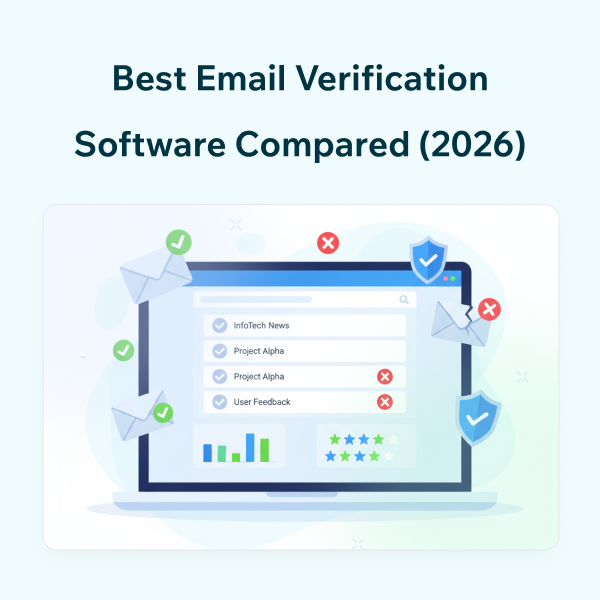
Best Email Verification Software Compared (2026)

> Best B2B Contact

How to Evaluate B2B Data Vendors for Accuracy and Compliance

TL;DR

Introduction

If your email campaigns aren’t getting the results they used to, your email list could be the reason. Outdated, fake, or invalid addresses increase bounce rates and make it harder for your emails to reach the inbox.

This is where investing in email verification software can be a lucrative business move. The software effectively checks every address before you send, helping you remove bad emails and reach real recipients. However, with so many options promising the best verification features, it’s easy to get overwhelmed.

That’s why we’ve compared popular email delivery tools to help you find the one that fits your budget, team, and email volume.

Why Businesses Need Email Verification Software

Every email address on a list of emails falls into one of a few buckets: valid and active, invalid or abandoned, a disposable email address created for a one-time signup, or a catch-all domain that accepts everything without confirming a real mailbox. Sending to the wrong bucket repeatedly is what damages deliverability over time.

Inbox providers track bounce rates, spam complaints, and engagement signals to decide whether your future emails land in the targeted inbox or the spam folder. A single bad send might not hurt much. A pattern of high bounce rates tells Gmail, Outlook, and Yahoo that your sending practices need to be leveled up, and that reputation is hard to rebuild once it slips.

This is where the email verification process earns its keep. Running a list through email verification software before you send catches dead addresses, typos, and disposable email address patterns before they ever reach a spam filter. For sales teams doing cold outreach, it also flags role-based and low-engagement addresses that rarely convert anyway.

Tip: Verify new leads at the point of capture, not just before a bulk send. A real-time check on your signup form lets you validate email addresses the moment they’re entered, instead of discovering typos and fake entries six months later.

Teams that treat verification as a one-time cleanup rather than an ongoing habit tend to see accuracy drift back down within months, since lists decay continuously as people change jobs and abandon old inboxes.

Best Email Verification Platforms at a Glance

Before the full side-by-side comparison, here’s a quick snapshot of the Email Verification Platforms covered in this guide and who each one tends to suit best.
Platform  Best Known For  Notable Strength 
ReachStream Prospect 
Verified contacts, built-in verification 
200M+ contacts, 20+ search filters, data enrichment 
Apollo.io 
All-in-one prospecting plus engagement 
Sequencing and dialing bundled in 
ZoomInfo 
Enterprise-grade intent data 
Deep firmographics and account based workflows 
Lusha 
Chrome extension prospecting 
Fast, lightweight LinkedIn lookups 
Cognism 
International, mobile-first data 
Strong EMEA phone number coverage 
Clearbit 
API-first data enrichment 
Built for developers enriching inbound leads 

No platform wins on every dimension, so it’s worth checking each vendor’s current pricing rather than trusting numbers that go stale. Apollo bundles prospecting with sales engagement tools, which suits teams that want it all in one subscription.

ZoomInfo leans enterprise, with intent data at enterprise-level pricing. Lusha and Clearbit stay lightweight (extension-based and API-first, respectively), while Cognism stands out for mobile number coverage and compliance-first sourcing in Europe.

Expert Insight
Experienced revenue operations teams rarely rely on a single data source for high-value accounts. It is common to see a primary contact database used for volume prospecting, paired with a secondary tool for verification before outreach goes out on strategic accounts. For a full head-to-head, see our ReachStream vs Alternatives breakdown.
Get ReachStream Prospect for $39 a Month
The Glacier plan unlocks 5,000 export credits across ReachStream Prospect’s full 200M+ contact database, no enterprise contract needed.

How ReachStream Prospect Fits into the Picture

ReachStream Prospect is built for teams that prioritize verified contact data, advanced filtering, and affordability over enterprise pricing. It’s a B2B prospecting database of 200M+ verified contacts with 20+ search filters, so you can build lead lists by title, industry, company size, and technographic signals instead of scrolling through irrelevant records.

Stop Guessing Which Emails Are Real
ReachStream Email Verifier can tell you which addresses are safe to send to before your next campaign goes out.
Pro Tip
Run a test batch of 100 to 200 contacts and check bounce rates after a week. The database with fewer bounces usually wins the real evaluation, regardless of total record count.
ReachStream Prospect’s Glacier plan starts at $39 per month with 5,000 export credits, which keeps it accessible for smaller teams that still want verified data. 
Put ReachStream Prospect to the Test
Search your actual target accounts and see the data quality for yourself, no demo list required. 

How to Choose the Right Platform

Whether you are evaluating a B2B contact database or a broader sales intelligence platform, the criteria below can help you compare providers more effectively.

Quick Checklist
Use these four checks before you sign anything 
Most B2B contact database evaluation failures we see trace back to skipping one of these steps under time pressure.
Common Mistake
Choosing a platform based on total database size alone. A billion-contact database sounds impressive until your actual target market, say mid-size healthcare practices, turns out to be a small, thinly covered slice of that total. 

Turning Data Into a Lead Generation Strategy

A B2B contact database is an input, not a strategy. Experienced teams typically work it this way:
  1. Build the list using filters to segment by ICP: title, industry, company size, location. 
  2. Verify before sending through an email verifier to protect deliverability. 
  3. Score and prioritize using firmographic fit plus any available buying signals or intent data. 
  4. Prioritize personalized outreach around specific triggers, a funding round, a new hire, a tech stack change,

Our Fanatical Prospecting ebook walks through building this kind of daily prospecting system in more depth.

Build Your Next Lead List in Minutes on ReachStream 
Stop stitching together spreadsheets from five different sources. 

Buying Considerations

Price is rarely the full story with B2B data providers. Some position themselves as a full B2B lead management software suite, others as lightweight B2B lead generation tools or simple lead gen software, but either way, a cheaper plan with poor data accuracy can cost more in wasted SDR hours and damaged sender reputation than a slightly pricier plan with clean records. Before you sign, confirm:
A five-person agency and a 200-person enterprise sales org will land on different platforms for good reasons, and that is fine. Clean lead generation data also simplifies lead management inside your CRM.

Conclusion

The best B2B contact databases aren’t the ones with the biggest headline number. They’re the ones that match your target accounts, refresh often enough to stay useful, and come with compliance you can hand to legal without a follow-up meeting. 

Whichever platform you land on, ReachStream Prospect, Apollo, ZoomInfo, Lusha, Cognism, or Clearbit, run the same test: pull a real batch of your own accounts and check accuracy, deliverability, and response rates. 

Ready to Fix Your Pipeline's Data Problem? 
Verified contacts, built-in enrichment, and filters that match how your team sells. 

Frequently Asked Questions

1. What is the best b2b lead generation software for small sales teams?

Small sales teams generally get the best value from B2B lead generation software priced by export credits rather than per-seat enterprise contracts. This keeps monthly costs predictable at low volume. Strong filtering matters more for small teams than raw database size, since it prevents credits from being spent on irrelevant contacts.
B2B contact data accuracy typically ranges based on the vendor’s refresh cadence and verification process, and varies significantly by platform. Buyers should request the vendor’s published accuracy percentage and refresh frequency before purchasing, then confirm both by testing a sample batch of contacts during a free trial.
A separate email verifier is not required if the contact database includes built-in verification. Platforms like ReachStream Prospect verify emails as part of the database itself, which removes the need for a standalone verification tool in most workflows.
Buying signals and intent data help B2B sales teams by identifying which accounts are actively researching a purchase, based on activity such as pricing page visits, related job postings, or competitor research. Sales reps who prioritize outreach to accounts showing active buying signals see higher response rates than reps working unranked cold lists.
A B2B contact database should hold GDPR and CCPA alignment at minimum if the buyer sells internationally or into the United States. ISO 27001 and SOC 2 certifications are the standard indicators that a vendor maintains strong data security practices.
B2B contact data should be refreshed every 30 to 45 days as a general benchmark. Contact information degrades quickly because people change jobs, get promoted, or switch companies on an ongoing basis, so refresh cycles longer than 45 days increase the risk of outdated records.
Existing CRM data can be enriched instead of replacing it with a new database. Data enrichment tools fill specific gaps, such as missing phone numbers or outdated job titles, in records that already exist, which is typically more cost-effective than starting over.
B2B contact database costs vary by size, export volume, and included features such as phone numbers or intent data. Entry-level plans can start well under $100 per month for lower export volumes, while enterprise plans with intent data and account-based features can run into the thousands. Exact pricing varies significantly by vendor, so buyers should calculate cost against actual monthly usage rather than comparing list prices alone.
Mohammed Younus

Author

Mohammed Younus
Senior Manager of Business Operations specializing in B2B Marketing, Business Development, and Process Optimization, driving operational efficiency and growth at ReachStream.
Share
Table of Contents

Access 200M+ verified business emails and grow your sales pipeline effortlessly.

Power Your Sales with Targeted Data
Mohammed Younus
Mohammed YounusAuthor
Mohammed Younus is the Senior Manager of Business Operations with a keen insight into the B2B landscape. Through his contributions to this blog, he aims to share cutting-edge tactics and insights that empower sales and marketing professionals to achieve unparalleled success.

Don't forget to share this post!

Check out our other blogs!