

How to Evaluate B2B Data Vendors for Accuracy and Compliance
US agencies need more than a large list of names. They need a dependable way to identify the right companies, reach the right decision-makers, verify business email addresses, detect buying signals, and move qualified contacts into the agency’s sales or marketing workflow.
That is why the best B2B contact database for an agency is not automatically the provider with the largest advertised record count. The right choice depends on the agency’s clients, target industries, campaign volume, geographic coverage, CRM, compliance requirements, and need for intent data.
For agencies seeking a focused prospecting and verification workflow, ReachStream is a strong option to evaluate. Its Prospect platform is positioned around contact and company search, business emails, direct dials, a LinkedIn Chrome extension, and a separate email-verification product. Apollo is another practical starting point because it combines contact search, prospecting, and engagement features in one platform. ZoomInfo is generally better suited to larger revenue teams that need broad account intelligence, advanced workflows, and intent signals. Cognism is worth considering for agencies that work across the US and Europe, while UpLead and Lusha can fit smaller teams that prefer simpler lookup and list-building workflows. Agencies already committed to HubSpot may prefer Breeze Intelligence, while LinkedIn Sales Navigator is useful when relationship context matters more than bulk email exports.
Provider | Best fit for US agencies | Main strengths | Watch-outs |
ReachStream | US agencies seeking focused prospecting and email verification | Contact and company search, business emails, direct dials, LinkedIn extension, email verification | Verify coverage, integrations, and the exact data fields included in the selected plan |
Apollo | Lean and mid-sized agencies running outbound campaigns | Contact and company search, filters, enrichment, sequencing, and CRM workflows | Validate deliverability for each client segment; feature breadth can encourage over-automation |
ZoomInfo | Enterprise agencies and complex account-based marketing programs | Large-scale account intelligence, intent, organizational data, enrichment, and workflow connections | Typically requires a larger budget and more implementation discipline |
Cognism | Agencies serving US and European markets | International coverage, phone data, and compliance-oriented positioning | Quote-based buying process; test coverage for the exact US industries and personas needed |
Lusha | Individual consultants and small agency teams | Fast contact lookup, browser-based prospecting, and straightforward workflows | May be less suitable for large-scale multi-client data operations |
UpLead | Agencies that prioritize transparent list building and verification | Contact search, email verification, and list-building workflow | Compare coverage and credit economics against the agency’s monthly volume |
LinkedIn Sales Navigator | Relationship-led agencies and strategic account research | Professional context, account discovery, and social selling | It is not a conventional bulk email database; export and outreach workflows require care |
Breeze Intelligence | HubSpot-centered agencies | Native enrichment, buyer intent, and CRM-connected data workflows | Strongest fit for agencies already operating inside HubSpot |
Lead411 | Agencies using trigger-based prospecting | Company and contact data plus event-oriented alerts | Confirm signal depth, coverage, and integration fit before purchasing |
RocketReach | Agencies needing individual professional lookups | Email and phone discovery for specific people | Better for targeted lookup than for every type of account-based program |
Seamless.AI | High-volume prospecting teams testing real-time discovery | Large-scale prospecting and contact discovery | Verify records before use and monitor credit consumption and deliverability |
6sense or Demandbase | Enterprise agencies running account-based marketing | Account identification, intent, advertising, and orchestration | Often more than a contact database; implementation and budget may be substantial |
A B2B contact database is a structured collection of business and professional records. A typical record may include a person’s name, job title, employer, business email, phone number, company size, industry, location, technology information, and other sales or marketing fields.
A B2B email database focuses primarily on work email addresses and related contact information. A broader B2B data provider may also offer firmographic data, technographics, intent signals, job-change alerts, funding events, org charts, CRM enrichment, and workflow automation.
The distinction matters for agencies. An agency may need a list of US marketing directors for one client, technology-install data for another, and account-level intent signals for a third. A single static contact database rarely performs all three jobs equally well.
Choosing the right B2B data vendor means looking beyond headline accuracy claims and evaluating the quality, coverage, and reliability of the data your agency actually needs.
Ask how the vendor verifies email addresses, direct dials, job titles, and company records. Also ask how often records are refreshed and what happens when a record is invalid.
Do not rely only on an advertised accuracy percentage. Instead, request a representative sample for the industries, job functions, company sizes, and states that your clients target. Test whether the contacts still work, whether the person holds the stated role, and whether the company matches the intended profile.
A useful agency test measures:
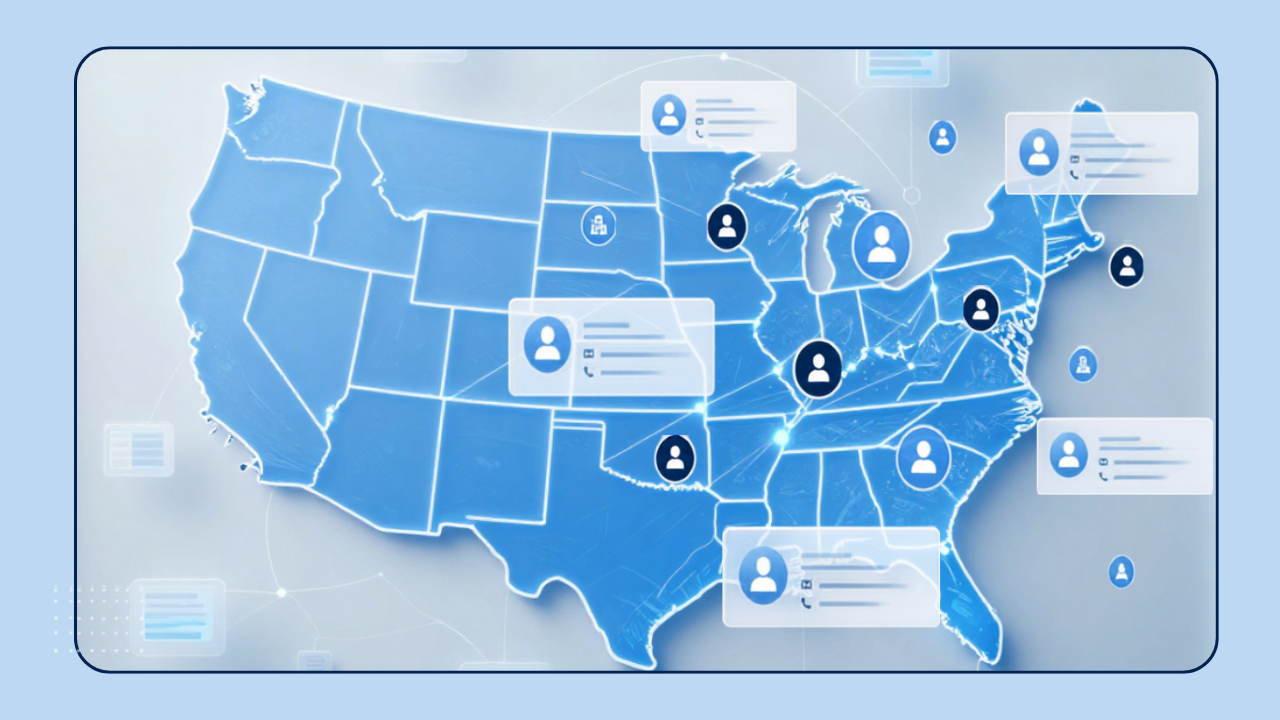
“US coverage” is not one universal metric. A provider may perform well for software companies and poorly for local healthcare organizations, construction firms, manufacturers, professional services companies, or public-sector suppliers.
Agencies should test coverage by industry, geography, company size, seniority, and role. For example, a campaign targeting Chief Financial Officers at 100–500-person SaaS companies requires a different data profile from a campaign targeting owners of regional construction firms.
B2B contact databases by intent add signals that indicate an account may be researching a topic, hiring for a relevant role, changing technology, receiving funding, or showing another behavior associated with a buying journey.
Intent data should be treated as prioritization evidence, not proof that an individual is ready to buy. It is usually more useful at the account level than as a reason to send an aggressive message to every employee at that company.
Ask these questions:
Firmographic filters describe the company. Common fields include industry, employee count, revenue range, headquarters, growth rate, and funding stage.
Technographic filters describe the software or infrastructure a company uses. They can help an agency build campaigns around a migration opportunity, integration, replacement category, or complementary product.
These filters are especially valuable for agencies because they make campaigns more specific. A list of “US businesses” is rarely actionable. A list of “US e-commerce companies with 50–200 employees using a selected platform and hiring for demand generation” is much closer to a campaign audience.
A database becomes more valuable when it fits the agency’s existing workflow. Check for native or supported connections to platforms such as Salesforce, HubSpot, Microsoft Dynamics, Pipedrive, Outreach, Salesloft, and advertising or automation tools.
The important questions are not only whether an integration exists, but also whether it supports:
A US business email database is not a substitute for a compliance program. Agencies should review the provider’s terms, data provenance, opt-out process, privacy documentation, and permitted use cases.
For US email campaigns, review the requirements of the CAN-SPAM Act, including truthful header information, non-deceptive subject lines, identification of commercial messages, a valid physical postal address, and a working opt-out mechanism. Agencies working with international recipients should also assess applicable regional privacy and electronic marketing rules with qualified legal counsel.
Do not purchase or use a database advertised as “free” unless the provenance, permission, freshness, and intended use are clear. A B2B contact database free download may be useful for research, but a low-cost list can become expensive if it produces bounces, complaints, compliance exposure, or poor campaign results.
Agencies have more B2B contact database options than ever, but the right tool depends on factors such as data accuracy, US coverage, targeting capabilities, pricing, and how easily the platform fits into your existing workflow.
best focused option for prospecting and email verification.
ReachStream positions itself as a B2B data platform for searching companies and leads, building targeted lists, accessing business emails and phone numbers, and validating email addresses before outreach. Its product suite includes Prospect, Email Verifier, and a Chrome extension designed to capture prospect information while browsing LinkedIn and Sales Navigator.
For a US agency, this combination can be useful when the immediate requirement is a targeted US business email database, a cleaned campaign list, or a repeatable workflow for finding decision-makers. ReachStream’s website reports global coverage across 150+ countries and 400+ industries, as well as 200M+ contacts; these are vendor-reported figures and should be validated against the agency’s specific client segments.
Best for: Agencies that want contact and company discovery, list building, LinkedIn-assisted prospecting, and email verification in a focused workflow.
Test before buying: Coverage for the exact US industries and job titles served by the agency, independent email-validity results, direct-dial availability, credit rules, CRM or export workflows, client-level data separation, and the practical cost per usable contact.
best all-in-one starting point for many agencies.
Apollo positions its search product around a large database of professional contacts and companies, precision filters, validated contact data, enrichment, intent signals, CRM export, and sales engagement.
It is a strong candidate for agencies that want to move from list building to outreach without stitching together several products. The platform can support prospect discovery, contact enrichment, and campaign execution in one environment.
Best for: Lean and mid-sized agencies, startup-focused agencies, and teams that need a combined B2B contact database tool and outbound workflow.
Test before buying: Email deliverability in each target segment, direct-dial coverage, export limits, duplicate handling, and the separation of data between client accounts.
best for enterprise-grade account intelligence.
ZoomInfo’s B2B contact database offering combines contact and company records with firmographics, technographics, organizational relationships, buying signals, intent, CRM enrichment, and sales-workflow connections.
It is a strong fit when an agency manages complex account-based marketing programs, large client datasets, or multiple teams that need a shared intelligence layer. The platform’s breadth may be unnecessary for a small agency that only needs occasional verified email lookups.
Best for: Enterprise agencies, ABM programs, and clients with mature CRM and revenue operations processes.
Test before buying: Total cost, contract structure, actual coverage for the client’s verticals, signal explainability, implementation effort, and user permissions.
best for agencies with international requirements.
Cognism focuses on sales intelligence, contact data, phone information, and compliance-oriented data practices. It can be considered by agencies that run campaigns across both the United States and European markets.
Best for: International B2B agencies and programs that depend heavily on phone-based prospecting.
Test before buying: US coverage by role and industry, mobile-number accuracy, regional permissions, suppression workflows, and the exact data included in the proposal.
best for quick prospect lookup.
Lusha is designed around finding professional contact information through a relatively direct prospecting workflow. It can be useful when an account executive, consultant, or small agency needs to identify a limited number of relevant contacts quickly.
Best for: Small teams, individual lookups, and focused account research.
Test before buying: Bulk-list economics, data depth, CRM syncing, and how well it handles multi-client agency operations.
best for controlled list building.
UpLead is often evaluated by teams that want a structured contact-search process with verification-oriented list building. Its fit depends on the agency’s required volume, target segments, and credit usage.
Best for: Budget-conscious agencies that want to build targeted lists rather than purchase the largest possible database.
Test before buying: Verification performance on a sample, credit expiry rules, company coverage, and integrations.
best for relationship-led research.
LinkedIn Sales Navigator is useful for finding accounts, mapping stakeholders, monitoring job changes, and understanding professional context. It should not be treated as a direct substitute for every B2B email database provider, especially when an agency requires bulk email exports.
Best for: Strategic account research, social selling, relationship mapping, and warm outreach.
Test before buying: How the team will source contact channels lawfully, manage notes, avoid duplicate outreach, and connect research to the CRM.
best for HubSpot agencies.
Breeze Intelligence is HubSpot’s data and intelligence layer for enrichment, buyer intent, and CRM-connected workflows. It is most compelling when the agency already manages client marketing and sales activity inside HubSpot.
Best for: HubSpot-focused agencies that want fewer disconnected tools.
Test before buying: Credit consumption, supported enrichment fields, portal-level permissions, client data separation, and the cost of scaling across multiple portals.
best for trigger-based prospecting.
Lead411 is a relevant option for agencies that want company and contact data combined with events or triggers that can help prioritize outreach. Trigger-based workflows can be more actionable than a static list when the agency has a clear hypothesis about which events matter.
Best for: Agencies building campaigns around hiring, funding, leadership changes, or other observable business events.
Test before buying: Signal freshness, industry coverage, CRM and automation integrations, and whether alerts create useful actions rather than noise.
best for targeted professional lookups.
RocketReach is commonly used for finding professional contact channels for specific people and companies. It can complement a broader database when an agency already knows the target account or person.
Best for: Executive research, account-based lists, recruiting-related campaigns, and limited-volume lookups.
Test before buying: Match rate for the agency’s target roles, phone coverage, verification process, and bulk-use terms.
best for teams evaluating high-volume discovery.
Seamless.AI appeals to teams that want high-volume prospect discovery and real-time contact finding. As with any large-scale data source, records should be independently checked before being added to a live campaign.
Best for: High-volume prospecting teams with a defined verification and suppression process.
Test before buying: Actual valid-email rate, credit usage, duplicate behavior, data provenance, export rules, and campaign bounce performance.
best for account-based marketing programs.
6sense and Demandbase are broader revenue and account-based marketing platforms rather than simple downloadable contact lists. They are relevant when an agency needs account identification, intent, advertising, orchestration, and measurement around target accounts.
Best for: Enterprise agencies managing sophisticated ABM and multi-channel programs.
Test before buying: Implementation requirements, data activation options, client reporting, CRM architecture, and whether the program justifies the platform cost.
A small agency should usually begin with a platform that supports targeted search, basic verification, CRM export, and manageable pricing. Apollo, UpLead, Lusha, or a combination of LinkedIn Sales Navigator with a verification tool may be reasonable starting points.
The correct choice depends on campaign design. If the agency sends a low volume of highly researched messages, relationship context may matter more than database size. If it runs repeatable outbound campaigns for several clients, filters, deduplication, suppression, and client-level workflow separation become more important.
A larger agency may benefit from ZoomInfo, Cognism, 6sense, Demandbase, or another enterprise platform when it needs broad account coverage, multiple integrations, intent signals, governance, and reporting. However, enterprise functionality only creates value when the agency has the operating process to use it.
Before signing, run a pilot with real client segments. Compare the provider’s records with the agency’s existing CRM, measure net-new coverage, check bounce and match rates, and document how the data will be refreshed and suppressed.
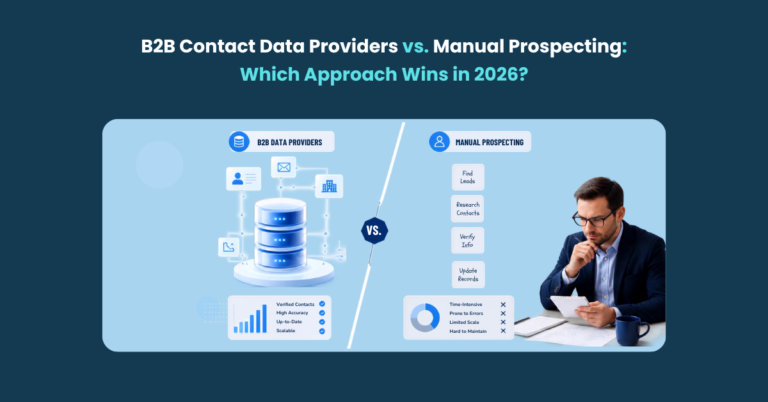
Buying a database is faster and usually more scalable than manually researching every company and contact. Building a first-party database, however, gives the agency more control over consent, source context, engagement history, and customer relationships.
The strongest operating model is usually a combination:
Do not compare only the monthly subscription price. Calculate the cost per usable contact:
Cost per usable contact = (subscription + verification + enrichment + workflow labor + campaign waste) ÷ contacts that pass your quality threshold
A cheaper list may cost more if it creates high bounce rates, manual cleanup, duplicate records, poor targeting, and client dissatisfaction. A more expensive provider may be justified if it reduces research time and improves qualified-conversation rates.
For agencies, also include the cost of administration. A provider that requires repeated manual exports may be inefficient across multiple clients, even if its raw data price appears attractive.
A structured 30-day evaluation gives agencies enough time to test data quality, coverage, integrations, and campaign performance before committing to a B2B data vendor.
Select two real client segments. Define the target industry, geography, company size, job titles, seniority, and required fields. Set quality thresholds before viewing the results.
Request or generate equivalent samples from two or three providers. Remove duplicates, independently verify emails, and check whether contacts still work at the stated companies.
Use a small, compliant campaign with honest messaging and a clear opt-out process. Measure deliverability, positive replies, qualified conversations, and unsubscribe or complaint signals. Do not judge a database on open rate alone.
Compare usable contacts, research time saved, campaign outcomes, integration quality, and administrative burden. Choose the provider that performs best for the agency’s actual clients, not the provider with the most impressive headline metric.
The best B2B contact database for US agencies in 2026 is the one that delivers usable contacts for the agency’s specific client segments and fits its compliance, CRM, and campaign processes.
Treat every vendor’s database size and accuracy claim as a starting point. The decisive test is a controlled sample against the agency’s real audience, real workflow, and real campaign-quality threshold.
There is no universal winner. Apollo is a practical starting point for many small and mid-sized agencies, while ZoomInfo is more appropriate for enterprise-grade account intelligence. The best provider depends on segment coverage, budget, integrations, intent requirements, and verification results.
Agencies can evaluate Apollo, ZoomInfo, Cognism, UpLead, Lusha, RocketReach, and other established B2B data providers. Before buying, request a sample, independently verify records, review data-use terms, and confirm the provider’s opt-out and compliance processes.
Free lists are often incomplete, outdated, or unclear about data provenance. They may be useful for market research, but agencies should not assume that a free list is permission-based, accurate, or suitable for commercial outreach.
The terms overlap. A contact database provider usually emphasizes people and company records. A broader B2B data vendor may also sell enrichment, firmographic data, technographics, intent, event signals, CRM synchronization, and workflow automation.
B2B contact database builders are tools or services that help users create targeted prospect lists from company, role, industry, geography, technology, and intent filters. Some build lists from a proprietary database, while others enrich records from multiple sources.
Update frequency depends on the field and provider. Job changes, company moves, email status, and phone numbers can change quickly, so agencies should refresh important records before activation and maintain an ongoing suppression and verification process.
No. Intent data is a signal that an account or audience may be researching a topic or showing behavior associated with a potential need. It does not prove that a particular person is ready to buy. Use intent to prioritize research and tailor relevance, not to make unsupported claims.
Marketing professional, specializing in SEO, content strategy, social media, performance marketing, prospecting, and demand generation.
Access 200M+ verified business emails and grow your sales pipeline effortlessly.
Don't forget to share this post!















Check out our other blogs!
ReachStream Prospect vs. Prospeo: Which Delivers More Accurate Data
B2B Data Enrichment: Complete Guide to Enriching Lead Data
The Complete Guide to B2B Data Verification in 2026
ReachStream Prospect Reviews in 2026: What Real Users Say on G2