Yes, for most sales and marketing teams the Apollo.io extension is worth using, at least on the free plan. It is a genuinely useful browser tool for finding verified emails, phone numbers, and account data without leaving LinkedIn, Gmail, or your CRM, and it costs nothing to try. The Apollo.io extension is a browser add-on that connects to Apollo’s database of 240M+ contacts and 30M+ companies, letting you reveal contact details and add prospects to outreach sequences directly from whatever page you’re on. Whether it’s worth paying for depends on your credit needs, how much you rely on LinkedIn specifically, and whether you already trust another data source more.
Before installing any prospecting extension, check how many free credits it gives you and what one credit actually reveals (email vs. phone). That tells you how far a free trial will really go.
The extension adds a small Apollo panel wherever you’re browsing. On LinkedIn and company websites it surfaces verified emails and direct-dial numbers for the person or account on the page. In Gmail it tracks opens, inserts email templates, and logs activity back to Apollo. Inside Salesforce and HubSpot it pushes new contacts and account data straight into your CRM without manual entry, and from Google Calendar it can surface prospect insights ahead of a meeting.
As of 2026, Apollo’s Chrome extension has more than 1,000,000 installs and a 4.7 out of 5 rating from over 2,200 reviews on the Chrome Web Store, making it one of the most widely used sales prospecting extensions available. That scale doesn’t guarantee it’s the right fit for your team, but it does mean most of the rough edges, like lag, credit confusion, or LinkedIn hiccups, are well documented by other users if you run into them.
Apollo says its extension delivers a 98% email accuracy rate through a multi-step, real-time verification process, backed by a contributor network it says keeps records current. In practice, independent reviewers report bounce rates closer to 5 to 10% on some lists, which is normal for any vendor pulling from a database this size, since even verified emails age as people change jobs. Treat the 98% figure as a ceiling, not a guarantee, and run a small test batch before trusting a list at scale.
Yes. The Gmail integration adds tracking, template insertion, and AI-assisted email drafting directly in your inbox, and logs sent messages back to Apollo automatically. The Salesforce and HubSpot integrations sync new contacts, update existing records, and let you launch sequences without switching tabs, which is one of the extension’s strongest selling points for teams already living in a CRM. Sequence steps, opens, and replies all show up on the same contact record, so reps and managers can see engagement history without switching between Apollo and the CRM.
It’s built to. The extension can pull verified contact information for the profile or company page you’re viewing and add that person straight into a sequence. That said, LinkedIn has tightened enforcement against scraping-style browser tools industry-wide, and Apollo’s own company page was restricted on LinkedIn in March 2025 over data-policy concerns. Apollo said the incident did not affect core platform functionality, but it’s a reminder that LinkedIn-side features on any prospecting extension can change without notice, so it’s worth building a workflow that doesn’t depend entirely on LinkedIn access. Some users have reported the extension’s LinkedIn panel loading slowly or failing to appear on certain profile pages since the restriction, so it’s worth testing on your own LinkedIn account before rolling it out to a full team.
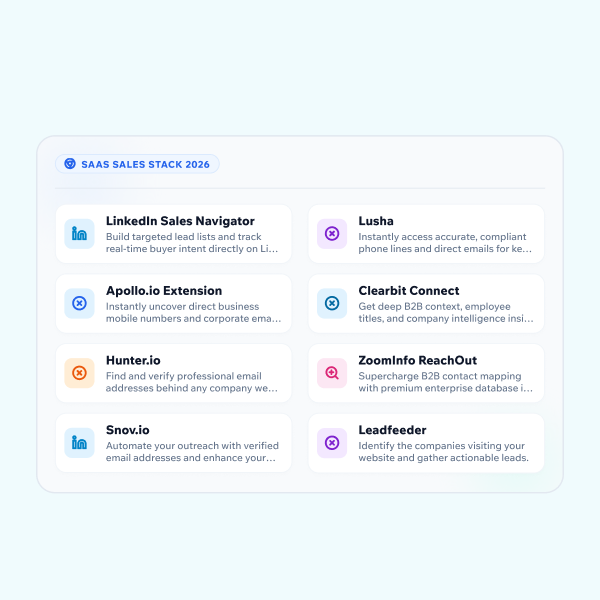
Apollo isn’t the only prospecting extension worth knowing about. Lusha’s extension focuses on in-context enrichment with one-click CRM syncing, similar to Apollo’s own CRM integrations. Hunter.io keeps things simpler, sticking to email discovery and verification without Apollo’s sequences and workflow features. Kaspr and LeadIQ both specialize narrowly in LinkedIn contact capture, revealing direct dials and emails through a lighter, single-purpose interface. If your prospecting is LinkedIn-only, a narrower tool like Kaspr can feel faster to use day to day; if you want one extension that also covers Gmail, CRM sync, and outreach sequences, Apollo’s broader scope is the tradeoff worth making.
More prospecting and lead-gen browser extensions have faced LinkedIn restrictions since early 2025, not just Apollo. If your outreach process depends heavily on LinkedIn-side scraping, plan for occasional disruption and keep an email-first fallback ready.
If credit caps or LinkedIn instability are holding your team back, see what a dedicated verified contacts database looks like side by side with a browser extension.
Manually researching a prospect across LinkedIn, their company site, and a verification tool can take 15 to 20 minutes per contact. The Apollo extension collapses that into a single click, revealing a verified email and phone number in seconds. The trade-off is credits: manual research costs time, extension use costs credits, and at scale the extension’s credit ceiling becomes the real constraint rather than time.
Take Priya, an SDR at a 35-person SaaS company. Prospecting 200 new contacts a month by hand would eat most of her week. With the Apollo extension on a Basic seat, she reveals verified emails and numbers straight from LinkedIn, with her CRM syncing automatically, in under an hour, leaving the rest of her week for actual outreach instead of research.
Turn on CRM sync before your first prospecting session. Reps who reveal contacts without pushing them to the CRM often end up re-searching the same person later and burning credits twice.
The extension itself is always free to install. What costs money is the underlying Apollo plan, because reveals are paid for with credits. The free plan gives 50 credits a month (1 credit per email, 5 per mobile number), which is enough to test data quality on a small list. Paid plans start at $49 per seat per month billed annually and raise both the credit allowance and the reveal limits, with API access unlocked from the Professional tier up.
Run a 50-to-100-contact test batch on the free plan before upgrading. Compare the bounce rate you actually see against Apollo’s 98% accuracy claim, and use that number, not the marketing number, to judge whether a paid seat is worth it for your team.
Ask sales and marketing to share one Apollo seat’s worth of test credits before buying separate licenses for each team. It’s the fastest way to see whether both teams get value from the same data source.
The Apollo extension is a strong fit for reps who need quick, in-the-moment contact reveals while browsing LinkedIn, a company site, or their inbox, especially on the free or Basic plan. It’s a weaker fit for teams that need to build large, verified contact lists in bulk ahead of a campaign, where credit caps and per-reveal pricing add up quickly. ReachStream Prospect is built for that second use case: searching and exporting verified company contacts at volume, with a free Ice Breaker plan for teams that want to compare data quality against what the Apollo extension surfaces on the same accounts.
Pull the same accounts through ReachStream Prospect and compare bounce rates, coverage, and cost per verified contact before you commit to a paid Apollo seat.
The Apollo.io extension earns its place in most prospecting stacks because it’s free to install, works across the tools reps already use, and gives a real way to test data quality before paying. It’s not the right tool for every job: heavy LinkedIn dependence and credit caps are real limitations. But for quick, verified contact lookups without leaving your browser, the Apollo.io extension is worth using.
See how ReachStream Prospect combines search filters, verification, and enrichment so you’re not relying on a single extension for every prospect.