


How to Evaluate B2B Data Vendors for Accuracy and Compliance
Your CRM is only as useful as the data inside it. And if your team is still manually copying contacts from spreadsheets or browser tabs, you’re losing hours that could go toward actual selling.
This guide breaks down the top B2B contact data providers with native CRM sync, what to look for when evaluating them, and how to avoid the most common buying mistakes.
B2B contact data providers supply verified email addresses, direct dials, and company intelligence to fuel outbound sales and marketing. The leading platforms right now include ReachStream, Apollo.io, ZoomInfo, Cognism, and Lusha. Each one offers native CRM integrations that push contacts directly into Salesforce, HubSpot, and other sales tools.
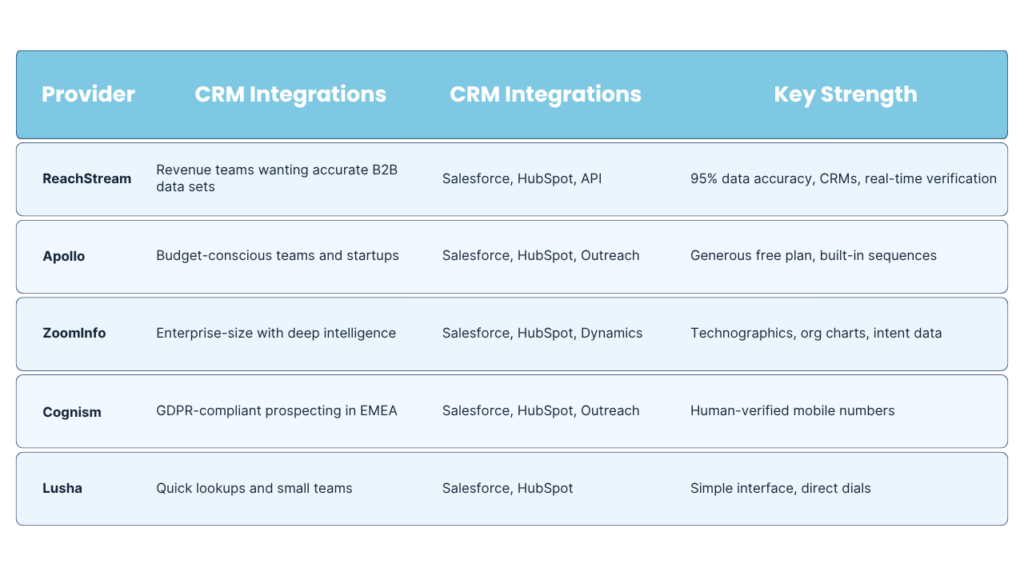
Which provider fits your team depends on size, target geography, and budget. Here’s a quick look:
A B2B contact data provider is a platform that aggregates, verifies, and delivers business contact information. We’re talking emails, phone numbers, job titles, and company details. The goal is simple: help your sales and marketing teams reach decision-makers directly without spending hours on manual research.
Think of it as a shortcut to starting real conversations. Instead of hunting through LinkedIn profiles or guessing at email formats, you get verified records ready for outreach.
Before evaluating providers, it helps to understand what you’re actually buying. Most platforms offer several data types, though coverage varies quite a bit.
Contact data includes verified emails, phone numbers, job titles, and LinkedIn profiles for individual decision-makers. This is the foundation of any outreach campaign.
Firmographics describe company-level attributes like industry, company size, annual revenue, and headquarters location. You use firmographics to define your ideal customer profile and filter accounts accordingly.
Technographics reveal the software and technology stack a company uses. If you sell a tool that integrates with Salesforce, knowing which prospects already use Salesforce helps you personalize your pitch.
Intent signals indicate when a prospect is actively researching solutions like yours. Rather than cold outreach to everyone, intent data helps you prioritize leads who are already in-market.
Hiring activity often reveals growth signals, budget availability, and organizational priorities. A company hiring five SDRs probably has pipeline goals and might be open to tools that help hit those targets.
Here’s where many teams overlook a critical factor. The best contact data in the world doesn’t help if it sits in a spreadsheet disconnected from your sales workflow.
Native CRM sync changes that equation entirely. When your data provider integrates directly with Salesforce, HubSpot, or your CRM of choice, several things happen automatically:
Without integration, you’re asking reps to manually import lists, update fields, and deduplicate records. That’s time they could spend selling.
Evaluating providers goes beyond comparing database sizes. Here’s what actually matters when you’re making a decision.
Look for multi-step verification processes that combine AI and human review. Accuracy directly impacts email deliverability and calling success. A provider stating 95% accuracy means fewer bounces and more conversations.
A database of 200M+ contacts sounds impressive. But how often are those records updated? Stale data leads to bounced emails and wrong numbers. Quality providers typically refresh records every 30 to 90 days.
Confirm native integrations with your existing CRM before committing. API access enables custom workflows for teams with specific automation requirements.
Advanced filters help you define and reach your ideal customer profile. A capable list builder should offer 20+ attributes including role, industry, company size, revenue, location, and technographics.
If you’re prospecting in Europe or California, ensure the provider aligns with GDPR and CCPA requirements. Non-compliance creates legal risk you don’t want.
Some providers use credit-based pricing where each export or lookup costs credits. Others offer seat-based or unlimited models. Understanding how credits are consumed matters before you sign.
Testing data quality before committing is always a good idea. Request sample exports or trial access to validate accuracy against your target market.

Now let’s look at each provider in more detail. We’ll cover what makes each one distinct and who benefits most from using it.
ReachStream is a B2B data platform built for revenue teams who want accurate, conversion-ready prospects without complexity. The platform offers 200M+ contacts with stated 95% accuracy, real-time email verification, and filtering by 20+ attributes including role, industry, company size, and revenue.
Best for: Revenue teams wanting accurate, CRM-ready contact data with transparent pricing
Key capabilities include:
ReachStream supports Salesforce, HubSpot, and custom API integrations, so contacts flow directly into your existing workflows.
Apollo.io works well for budget-conscious teams and startups. The generous free plan includes access to a global database of 200M+ contacts, plus built-in sequencing tools for outreach automation.
Best for: Teams wanting an all-in-one platform with prospecting and engagement
ZoomInfo remains the industry standard for enterprise sales teams. You get deep technographic data, organizational charts, and buyer intent signals. The investment is significantly higher than alternatives, though.
Best for: Enterprise organizations with comprehensive sales intelligence requirements
Cognism focuses on GDPR compliance with human-verified mobile numbers. The platform is especially strong for teams prospecting in Europe, with 400M+ contacts covering international markets.
Best for: EMEA-focused teams prioritizing compliance and phone accuracy
Lusha offers a simple interface for quick lookups. Small teams appreciate the straightforward approach to finding direct dials and verified emails with native Salesforce and HubSpot sync.
Best for: Small teams wanting fast, simple contact lookups
Now part of HubSpot as Breeze Intelligence, Clearbit excels at real-time enrichment and form optimization. The strong API makes it popular with developers building custom workflows.
Best for: HubSpot users and teams with developer resources
UpLead emphasizes a data accuracy guarantee with real-time verification. It’s a solid mid-market option with CRM integrations and transparent pricing.
Best for: Mid-market teams wanting accuracy guarantees
Seamless.AI uses AI to search the web for real-time contact discovery and verification. Teams wanting highly recent, on-demand data find value in this approach.
Best for: Teams prioritizing real-time, AI-powered discovery
RocketReach works well for individuals and researchers wanting quick lookups across 700M+ profiles. The browser extension simplifies one-off searches.
Best for: Individual users and researchers
Lead411 includes intent data and trigger alerts for timely outreach. The unlimited access model appeals to high-volume prospecting teams.
Best for: High-volume teams wanting intent signals
Kaspr excels at European LinkedIn prospecting with a highly rated Chrome extension for real-time B2B data extraction.
Best for: LinkedIn-focused prospecting in Europe
Sales Navigator offers unmatched access to 1B+ network members and real-time job changes. It’s ideal for relationship-based selling, though you’ll typically use separate tools for contact export.
Best for: Relationship-based selling and account research
Many companies invest in B2B contact data expecting immediate pipeline growth, but poor data quality, weak targeting, and outdated records often lead to disappointing results.
Manual data entry wastes time and introduces errors. Always confirm native integration with your CRM before purchasing.
A smaller, verified database outperforms a massive list of outdated contacts. Accuracy drives deliverability, and deliverability drives results.
Ask how often records are updated. Stale data means bounced emails and wrong numbers, which damages sender reputation over time.
Confirm GDPR and CCPA alignment before prospecting in regulated regions. Non-compliance creates legal risk that’s not worth taking.
Understanding how credits are consumed matters. Export limits and enrichment calls can inflate costs quickly if you’re not paying attention.
The right B2B contact data provider does more than supply names and emails. It integrates into your existing workflows, keeps your CRM clean, and helps your team spend less time researching and more time connecting with the right people.
When you’re evaluating options, prioritize accuracy over database size, confirm CRM sync capabilities, and test data quality against your actual target market before committing.
Providers aggregate data from public sources, web scraping, partnerships, and user-contributed information. Then they verify records through automated and manual processes.
Compliance depends on the provider. Look for platforms that source data ethically, honor opt-out requests, and align with GDPR and CCPA requirements for your target regions.
Quality providers refresh records every 30 to 90 days to account for job changes, company moves, and outdated contact information.
Small businesses benefit from providers with transparent pricing, free tiers or trials, and native CRM integrations. Platforms like ReachStream and Apollo.io fit this profile well.
Most providers offer native integrations that push verified contacts directly into your CRM, enrich existing records, and keep fields updated automatically.
Marketing professional with a Master’s degree in Marketing, specializing in SEO, content strategy, social media, performance marketing, prospecting, and demand generation.
Access 200M+ verified business emails and grow your sales pipeline effortlessly.
Don't forget to share this post!















Check out our other blogs!
ReachStream Prospect vs. Prospeo: Which Delivers More Accurate Data
B2B Data Enrichment: Complete Guide to Enriching Lead Data

The Complete Guide to B2B Data Verification in 2026
ReachStream Prospect Reviews in 2026: What Real Users Say on G2