
Q3 Limited-Time Deal. Find verified B2B leads at half the cost. Get 50% Off with Coupon Code PROSPECT50. First 200 Users Only.
Email Verification API: Verify Email Addresses at Scale in 2026
Written by:
Abdul Kareem

Email Verification API 2026: Verify Emails at Scale

> Email Verification

How to Evaluate B2B Data Vendors for Accuracy and Compliance

TL;DR

If you’ve ever watched a cold email campaign quietly fail because half the list bounced, you already understand why teams rely on an email verification API. Most teams do not think about this until a domain gets flagged or a CRM fills up with dead contacts. 

By 2026, mailbox providers have gotten stricter about what they let through. Bulk sender rules, spam trap detection, and engagement-based filtering all mean sending to unverified addresses carries more risk than it used to. One bad address is not a problem. Ten thousand of them can quietly damage a sender reputation that takes months to rebuild. 

This guide explains what an email verification API does, how real-time verification differs from batch verification, and what to consider when comparing providers. 

What Is a Email Verification API and Why It Matters

An email verification API is a service that validates email addresses automatically before they are added to your database or used in email campaigns. By integrating with your website, CRM, application, or lead capture forms, the API checks whether an email address is properly formatted, belongs to a valid domain, and can receive emails. Instead of finding out an address bounced after the fact, you find out beforehand. 

Most tools in this category check three layers: 

A syntax check alone tells you almost nothing. It will pass “notreal@gmail.com” just as happily as a real inbox if the format looks correct, which is why teams relying only on format checks still see high bounce rates.
Tip
If your current process only checks for an “@” symbol and a plausible domain, you are formatting email, not validating email. Real validation confirms the mailbox itself exists.

How the Verification Process Works

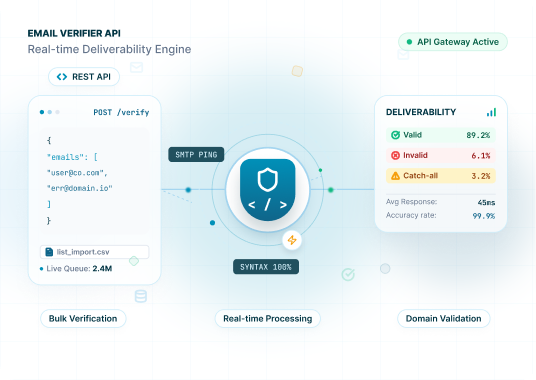
When you request an email verifier API, a few things typically happen behind the scenes:
  1. The request parses the address and confirms it is structurally valid. 
  2. It looks up the domain’s mail exchange records to confirm mail can route there.
  3. It runs a mailbox-level check, often an SMTP handshake, to see whether the receiving server accepts or rejects that address.
  4. It returns a status, ideally more detailed than a flat valid or invalid flag.
That last point matters most. A well-built email address validation API will not just tell you an address is good or bad, it will tell you why: 
Status  What It Means  What To Do 
Valid 
Mailbox exists and accepts mail 
Safe to send 
Invalid 
Mailbox does not exist or domain is dead 
Remove from list 
Risky 
Mailbox may exist but shows warning signs 
Send with caution or exclude 
Catch-All 
Domain accepts mail to any address 
Treat as unverified, monitor engagement 
Unknown 
Server did not respond conclusively 
Retry later or review manually 
Do Not Mail 
Role account, complainer, or suppression list 
Exclude 

Real-Time Verification vs Bulk Verification

Most teams end up needing both real time email validation and batch processing, for different jobs.

Real Time Email Verification

This runs at the point of capture, usually on a signup form or CRM field. The moment someone types an address, a check runs before the form submits, catching typos like “gmial.com” instead of “gmail.com” while the person can still fix it. 

Best for: signup and lead capture forms, CRM data entry, demo request forms.

Bulk Verification

This processes a list of addresses at once, through a file upload or a bulk call to an email API. It suits cleaning an existing database or prepping a list before a cold outreach campaign. 

Best for: pre-campaign list cleaning, quarterly database hygiene, verifying purchased or aggregated lists. 

PRO TIP   
Run real time checks at capture and batch verification on a recurring schedule, monthly or quarterly depending on volume. An address that was valid six months ago is not guaranteed to be valid today. 

Key Features to Look For

Not every email validation API on the market checks the same things. A few features separate the useful email verification API tools from the surface-level ones. 

Common Mistakes Teams Make

Even with an email verification API in place, a few common mistakes can reduce deliverability and increase bounce rates. Avoid these pitfalls to keep your contact database clean and your email campaigns performing at their best.

Choosing the Right Provider

Picking between email verifier APIs usually comes down to a handful of practical questions.
INDUSTRY INSIGHT 
Deliverability guidance from major mailbox providers has consistently emphasized low bounce rates and near-zero complaint rates as a condition for reliable inbox placement. That is a big part of why email address validation has become a standard step in most outbound workflows.

A Practical Rollout Framework

Step 1:

Audit your current list: Run a batch pass on your existing database for a baseline bounce risk score.

Step 2:
Add real time checks at capture points: Wire verification into signup forms, demo requests, and CRM fields so new bad data stops coming in.
Step 3:
Segment by status: Route valid addresses to your primary sending flow, treat risky ones with a lighter touch, and suppress invalid ones.
Step 4:

Re-verify on a schedule: Monthly for high-velocity outbound teams, quarterly for smaller lists.

Step 5:
Track bounce rate: If verified sends still produce bounce rates above roughly 2 percent, something upstream needs a second look, whether that is list sourcing, verification settings, or send cadence.
QUICK CHECKLIST 

ReachStream Email Verifier: Amplifying Campaign Success

Whether you’re validating email addresses as they’re collected or cleaning large contact databases before a campaign, the ReachStream Email Verification API helps you maintain cleaner data, reduce bounce rates, and protect your sender reputation.

Designed for developers and businesses alike, the API supports both real-time email verification and bulk validation. You can integrate it with websites, signup forms, CRM platforms, marketing automation tools, and custom applications to automate email verification within your existing workflows. It also scales easily for bulk list cleaning, helping ensure only valid, deliverable email addresses remain in your database.

Key capabilities include: 

Tip
Built for scale: Process high volumes of email verification requests with fast response times and seamless integration into your existing technology stack. 
See How Your List Scores 
Run a sample batch through ReachStream Email Verifier and see the status breakdown for yourself.

Why Email Verification Pays Off 

Most email verification API solutions price around credits or per-check costs, with tiered discounts at higher volumes. Before comparing sticker prices, it helps to think about the cost of not verifying.

A bounced send does not just fail quietly. A pattern of high bounce rates can affect sender reputation for your whole domain, meaning reduced inbox placement for everything you send afterward, for weeks or months while you rebuild trust.

A simple way to frame it: 

Ready to Integrate Email Verification into Your Workflow?
Use the ReachStream Email Verification to validate email addresses in real time across your applications. Keep invalid contacts out of your database from the start.

Conclusion

An email verification API is no longer optional for teams sending high volumes of outbound or lifecycle emails. Mailbox providers now place greater emphasis on bounce rates, and rebuilding a damaged sender reputation can take significant time. By integrating email verification into their data pipeline instead of treating it as a one-time cleanup task, businesses can maintain better deliverability and avoid costly email performance issues. 

Whether you need real time checks at capture, batch cleaning for an existing database, or both, the core questions stay the same: how detailed are the results, how well does it fit your stack, and how well does it perform against your own data. ReachStream Email Verifier is worth testing directly, with 100 free credits on signup to run a real check before deciding on anything larger. 

Start Verifying Emails for Free 
Upload your list, verify every address, and improve deliverability before you hit send. 

Frequently Asked Questions

1. What does an email verification API actually check?

It typically checks address syntax, whether the domain has valid mail exchange records, and whether the specific mailbox exists and accepts mail. More advanced tools also flag catch-all domains and disposable inboxes.
Yes. ReachStream Email Verifier supports both verification methods. Real-time verification checks an email address the moment it is entered into a form or application, preventing invalid contacts from entering your database. Bulk verification processes thousands of email addresses at once, making it ideal for cleaning CRM databases and marketing lists before a campaign.
The impact depends on the quality of your email list, but verifying addresses before sending is one of the most effective ways to reduce hard bounces. ReachStream Email Verifier identifies invalid, risky, and undeliverable email addresses so you can improve deliverability and protect your sender reputation.
A catch-all domain accepts emails sent to any address within that domain, making it difficult to confirm whether a specific mailbox is actively monitored. ReachStream Email Verifier detects catch-all domains and flags them as Risky, helping you make informed decisions before sending email campaigns.
Yes. ReachStream Email Verifier identifies disposable and temporary email addresses along with role-based accounts, catch-all domains, and other risky contacts. This helps you maintain higher-quality customer data and reduce unnecessary email bounces.
For the best results, verify your email list regularly. High-volume outbound teams should verify monthly, while smaller databases can be cleaned quarterly. ReachStream Email Verifier makes ongoing email verification easy through both bulk uploads and real-time verification.
Yes. New users receive 100 free verification credits upon signup, allowing them to test ReachStream Email Verifier with their own email lists before upgrading to a paid plan. No credit card is required to get started.
A Risky status indicates that an email address may be deliverable but has characteristics that could affect deliverability, such as catch-all domains or inconsistent mail server responses. ReachStream Email Verifier categorizes results as Valid, Invalid, Risky, Unknown, and Do Not Mail, making it easier to decide which contacts to include in your campaigns.
Yes. ReachStream Email Verifier supports bulk email verification for CRM exports, while the email verification API enables real-time verification within CRM systems, websites, signup forms, marketing platforms, and custom applications. This helps automate email verification and maintain clean contact data across your workflows.
Abdul Kareem

Author

Abdul Kareem
Abdulkareem Satarkar is Software Engineering Manager at ReachStream, leading the development of scalable software solutions for B2B sales and marketing teams.
Share
Table of Contents

Access 200M+ verified business emails and grow your sales pipeline effortlessly.

Power Your Sales with Targeted Data
Abdul Kareem
Abdul KareemAuthor
Abdul Kareem, Software Manager at ReachStream, has extensive experience in DevOps and backend technologies such as Python and PHP. He focuses on seamless project execution, maintaining optimal performance, and upholding the highest quality standards.

Don't forget to share this post!

Check out our other blogs!