



>Email Verification Guide
How to Evaluate B2B Data Vendors for Accuracy and Compliance

If you have ever launched a cold outreach campaign only to see high bounce rates, you already know the cost of unverified data. Unreliable email addresses do not just fail quietly. They damage your sender reputation and quietly erode the return on every campaign you run.
This email verification guide breaks down what email verification is, how it works, and why it has become a standard step for sales professionals, SDRs, marketing teams, and RevOps leaders who depend on email to reach real people.
Email verification is the process that is used to determine the accuracy and deliverability of an email address. It helps you ensure that the recipient is valid, active, and able to receive emails before you send anything to it. Instead of finding out an address is dead after you hit send, verification tells you upfront whether it is safe to mail.
At its core, it looks at three things: whether the address is formatted correctly, whether the domain exists and accepts mail, and whether the specific mailbox is active. Basic email validation might only confirm formatting and domain existence. A fuller verification tool goes further and checks the mailbox itself, often through a real-time verification ping to the receiving mail server.
This distinction matters more than it sounds. Plenty of teams treat “validation” and “verification” as interchangeable, but validation usually stops at syntax and domain checks, while verification confirms deliverability at the mailbox level. Throughout this email verification guide, we use “verification” to mean the fuller check, since that is what actually protects your sender reputation.
If a tool only tells you an email “looks valid,” ask whether it performed a mailbox-level check. Syntax checks alone will not catch a full inbox or a mailbox that was closed last month.
Every B2B email list decays over time. People change jobs, companies get acquired, domains get retired, and inboxes fill up. This is email list decay, and it happens whether you notice it or not.
The practical consequence shows up in your bounce rates. Email providers like Gmail, Outlook, and Yahoo consider signals such as how often mail from your domain bounces or gets marked as spam. Cross a certain threshold and your emails start landing in spam folders, even for contacts who genuinely want to hear from you. That is why email delivery and list hygiene are so closely tied together, a link this email verification guide keeps coming back to.
For sales professionals and SDRs, the stakes are direct. A cold outreach sequence built on unverified data wastes rep time chasing addresses that never existed. For email marketers running campaigns at scale, a handful of bad addresses can quietly erode engagement metrics and skew reporting.
Experienced revenue teams treat verification as a recurring habit, not a one-time cleanup. Lists sourced months ago need a re-check before a new send, since email list decay does not pause between campaigns.
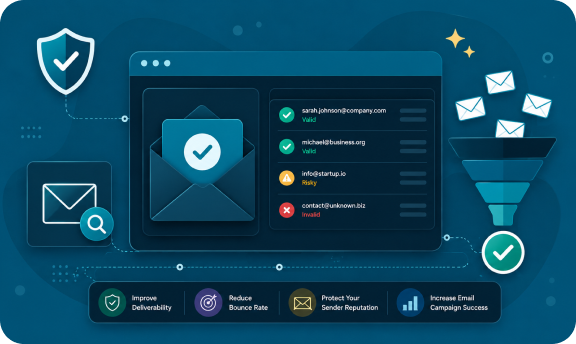
Most well-built platforms return a status for each address instead of a flat yes or no. Common statuses include Valid, Invalid, Risky, Catch-All, Unknown, and Do Not Mail, each pointing to a different next step for the sender.
Do not treat “Risky” and “Invalid” the same way. Risky addresses, often catch-all or low-confidence domains, can sometimes be worth a cautious, low-volume send, while Invalid addresses should be removed outright.
Not every approach is equally reliable. A few mistakes come up often enough to call out.
As this email verification guide has touched on already, not every provider works the same way. Providers generally fall into a few categories.
| Type | What It Does | Best For |
|---|---|---|
|
Standalone verifier |
Focused purely on checking and cleaning lists |
Teams that already have a data source and just need verification |
|
Built into a CRM or ESP |
Verifies addresses as part of a broader platform |
Teams that want it tied into existing workflows |
|
Bulk email checker |
Processes large lists in batch uploads |
List cleanups, database audits, one-time large jobs |
|
API-based |
Verifies in real time as addresses are captured, often on signup forms |
Product and growth teams verifying at the point of collection |
A standalone tool tends to be simple to adopt and does not require switching your existing CRM, while a built-in option can save a step if verification is only one part of what you need.
These two approaches solve different problems, and most teams end up needing both.
Real-time verification checks an address the moment it is captured, often through an API call on a signup form or CRM entry point. It suits founders and growth teams who want clean data from day one, and recruiters and agencies verifying candidate or client emails on intake.
Bulk email checking is built for the opposite scenario: you already have a list, sometimes tens of thousands of contacts, and need to verify it in one pass. This is common before a large campaign or during a periodic database cleanup.
If your email marketing strategy includes re-engagement campaigns for dormant subscribers, verify that segment separately. Dormant addresses are disproportionately likely to have gone stale.
Email list decay is not a hypothetical risk. It happens steadily, in the background, regardless of how good your data source was on day one. Teams that maintain strong deliverability are usually the ones that treat verification as a routine practice rather than a one-time fix.
This email verification guide has covered what verification actually checks, the methods behind it, the benefits and pitfalls worth knowing, and how to evaluate a provider against your own needs. The short version: verify before you send, segment by status, and re-check lists that have gone quiet for a while.
If you are ready to see how your own list holds up, ReachStream Email Verifier gives you a straightforward way to check it, with clear statuses for every address and free credits to get started.
See exactly which addresses on your list are safe to send to, before you hit send.
Author

Access 200M+ verified business emails and grow your sales pipeline effortlessly.
Don't forget to share this post!















Check out our other blogs!
The Complete Guide to B2B Data Verification in 2026

Cold Email vs. LinkedIn Outreach: Which Wins in 2026?
How Many Follow-Ups Should a Cold Email Sequence Have?
ReachStream Prospect vs. Prospeo: Which Delivers More Accurate Data