

How to Evaluate B2B Data Vendors for Accuracy and Compliance

>How Real-Time Email

Real-time email verification confirms whether an email address exists and can receive mail, checked at the exact moment you submit it rather than against a stale, previously collected list. That distinction matters more than it sounds. An address that was valid three months ago might belong to someone who left the company, closed the account, or let the inbox fill up since then.
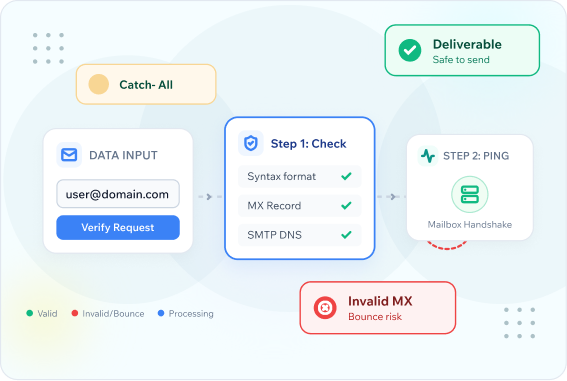
Most people confuse this with a simple format check. Confirming that an address looks like name@company.com is not the same as confirming the email address exists. Real email validation goes several steps further, checking the domain, querying the mail server, and flagging patterns associated with fake email or disposable email addresses. Teams that validate email addresses before sending emails consistently see fewer bounces than those who clean their list only after a campaign underperforms.
This article serves as a practical email verification guide covering what real-time email verification actually checks, the technical steps involved, how it differs from bulk verification, and what to look for in an email verification tool if you decide to add one to your stack.
This is the step that separates real time email verification from basic format checking. The verification service connects to the receiving mail server and asks whether the specific mailbox exists, without actually sending a message. The server’s response determines whether the address is deliverable.
Email verification has become a standard part of data hygiene for any team that measures deliverability seriously, since inbox providers increasingly weigh sender reputation when deciding whether to route mail to the inbox or the spam folder. A single sequence of bad sends can affect deliverability for campaigns that follow, not just the one that triggered it.
Both approaches serve different purposes, and most sales and marketing teams end up using both at different points in their workflow.
| Factor | Real-time verification | Bulk verification | Best moment to use it | Limitation |
|---|---|---|---|---|
|
When it runs |
At the point of entry, such as a signup form |
On an existing list, all at once |
Real-time at collection, bulk before a send |
Real-time needs API integration |
|
Speed per address |
Near instant |
Minutes to hours for large lists |
Real-time for live forms, bulk for campaigns |
Bulk jobs queue during high volume |
|
Best for |
Stopping bad data at the source |
Cleaning a list that already exists |
Use both together for full coverage |
Neither replaces the other |
|
Typical cost model |
Per API call or credit |
Per batch or per thousand addresses |
Match the model to your volume |
Free tiers cap both differently |
A bounced email is not a neutral event. High bounce rates signal to inbox providers that a sender may not be following good list hygiene practices, which can affect whether future emails land in the targeted inboxes or the spam folder for that domain going forward.
Treat any bounce rate above roughly two percent as a signal to pause and audit your list, not just a number to note and move past. Sustained bounce rates above that threshold tend to correlate with real deliverability problems building underneath the surface.
Verifying a list once at collection and never again. Email addresses decay over time as people change jobs and companies retire old domains. A list that was clean a year ago is not guaranteed to be clean today, especially for B2B contacts where job changes are frequent.
Ask any email verification tool or email checker what percentage of results fall into an ambiguous or unknown category. A high unknown rate often means the provider is being conservative to protect its own accuracy claims, and you will need a secondary check for those addresses.
ReachStream Email Verifier is built specifically around this problem: confirming an address is real and deliverable before it ever reaches an outreach sequence or marketing send.
Every checked address is sorted into one of six verification statuses: Valid, Invalid, Risky, Catch-All, Unknown, or Do Not Mail, so you can see exactly why an address was flagged rather than getting a single pass or fail result. The service reports 99.8% accuracy on verified results, and supports batch uploads of up to 25,000 emails per CSV file, up to 10 MB per file. Data handling follows ISO 27001:2022, SOC 2, GDPR, CCPA, PIPEDA, and DPDPA compliance standards.
New accounts can start with a 30-day free trial that includes 100 credits and no credit card requirement, enough to verify emails with ReachStream on a real sample before deciding whether the accuracy holds up for your specific list. Paid plans begin at $15/month for 5,000 credits, and the Email Verification API is included starting at the Pro tier — ideal for teams looking to integrate verification directly into a signup form or internal workflow.
Real-time email verification is not a single check. It is a short technical sequence: syntax, domain and MX lookup, SMTP handshake, and disposable address detection, all run at the moment an address is submitted. Understanding those steps makes it easier to evaluate any Email Validation tool honestly, rather than trusting a vendor’s accuracy claim at face value.
Pair real-time verification at the point of collection with periodic bulk verification of your existing list, since contact data decays over time regardless of how clean it was originally. ReachStream Email Verifier’s six verification statuses and 30-day free trial make it straightforward to test that process on a real sample before committing budget.
Author

Access 200M+ verified business emails and grow your sales pipeline effortlessly.
Don't forget to share this post!















Check out our other blogs!
ReachStream Prospect vs. Prospeo: Which Delivers More Accurate Data
B2B Data Enrichment: Complete Guide to Enriching Lead Data
The Complete Guide to B2B Data Verification in 2026
ReachStream Prospect Reviews in 2026: What Real Users Say on G2