


How to Evaluate B2B Data Vendors for Accuracy and Compliance
Modern B2B sales rely on technology to manage increasingly complex buying journeys. Decision-makers expect personalized communication, accurate information, and timely follow-ups, making manual sales processes difficult to scale. Businesses now use B2B sales software to automate prospecting, organize customer relationships, improve outreach, and measure sales performance.
Rather than depending on a single platform, successful organizations build a sales technology stack where different software categories work together throughout the lead generation process. From identifying potential buyers to nurturing qualified opportunities, every solution contributes to improving efficiency and revenue growth.
This guide explains the major categories of B2B sales software, how they support lead generation, and how businesses can choose the right combination of tools to build a scalable and effective sales process.
Lead generation has become more data-driven than ever before. Sales teams must identify qualified prospects, engage multiple stakeholders, maintain consistent communication, and monitor performance across every stage of the sales pipeline. Managing these activities manually often leads to missed opportunities and lower productivity.
B2B sales software simplifies these challenges by automating repetitive tasks, organizing customer data, and providing insights that help teams make better decisions. Instead of replacing sales professionals, technology gives sales teams more time to engage prospects and drive conversions by automating repetitive tasks.
Modern sales software supports business growth in several ways:
Businesses that use an integrated sales technology stack can improve sales productivity, maintain better customer data, and create a more consistent buying experience.
A successful sales technology stack includes multiple software categories, each designed to support a specific stage of lead generation. Instead of selecting tools based on popularity, businesses should understand the purpose of each category and how they work together to improve sales performance.
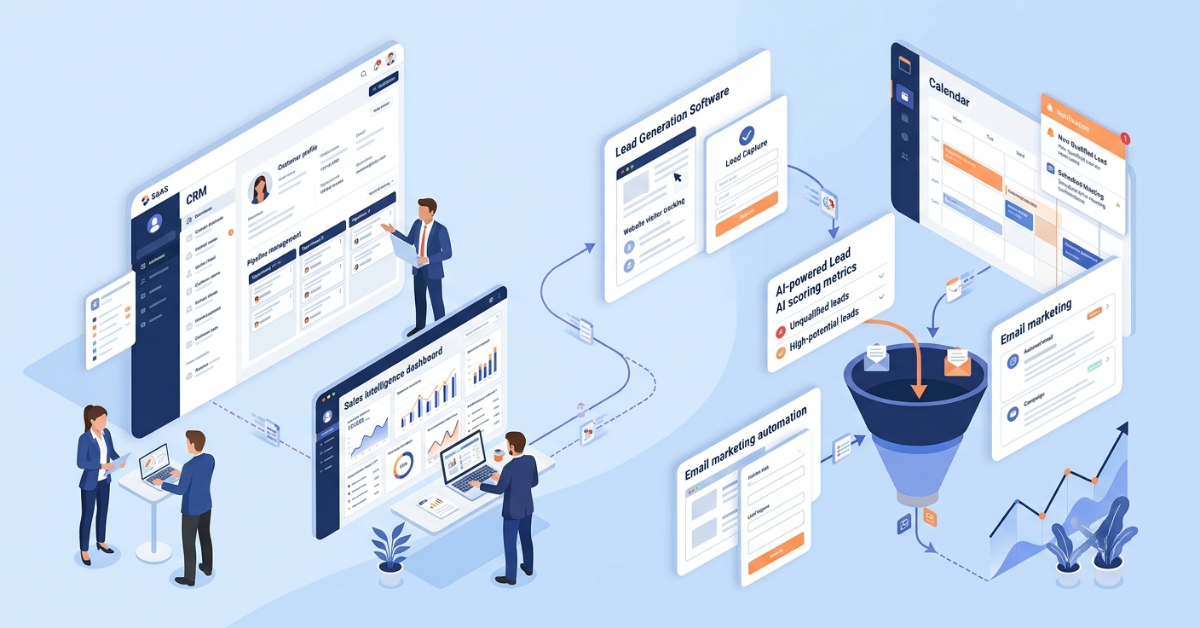
CRM Software centralizes customer information, tracks opportunities, manages sales pipelines, and records every customer interaction.
Sales Intelligence Platforms provide company insights and firmographic data that help businesses identify organizations matching their ideal customer profile.
Prospecting Tools help sales teams discover new businesses and decision-makers using filters such as industry, company size, location, and job title.
Email Outreach Platforms automate personalized email campaigns, follow-ups, and engagement tracking while improving communication efficiency.
Marketing Automation nurtures leads through targeted campaigns until they are ready for direct sales engagement.
Lead Enrichment Tools enhance customer records by adding missing business and professional information for better segmentation and personalization.
Email Verification Software validates email addresses before campaigns begin, improving deliverability and reducing bounce rates.
Sales Engagement Platforms coordinate communication across email, calls, and other channels to maintain consistent prospect engagement.
Analytics and Reporting Tools measure campaign performance, pipeline health, conversion rates, and overall sales productivity.
Prospect Discovery | Prospecting Tools | Find target businesses |
Research | Sales Intelligence | Understand prospects |
Data Improvement | Lead Enrichment | Complete customer records |
Validation | Email Verification | Improve data quality |
Pipeline Management | CRM Software | Manage customer relationships |
Outreach | Sales Engagement | Automate communication |
Lead Nurturing | Marketing Automation | Build long-term engagement |
Performance Tracking | Sales Analytics | Measure business results |
Every category of B2B sales software contributes to the sales process, but some have a more direct influence on generating and converting leads. Businesses that consistently achieve better results combine prospecting, data quality, customer relationship management, outreach, and analytics to create a streamlined lead generation strategy.
Lead generation starts with identifying businesses that match your ideal customer profile. Prospecting tools and business contact databases let sales teams search for companies by industry, location, company size, revenue, technologies used, and decision-maker roles.
Instead of spending hours manually researching potential customers, sales representatives can quickly build targeted lead lists. This helps teams focus on high-potential prospects, improving efficiency and increasing conversion rates.
Not every prospect is ready for a sales conversation. Before outreach begins, businesses should ensure that lead information is complete and accurate.
Lead enrichment tools add valuable firmographic and contact details, while email verification software validates email addresses before campaigns are launched. Together, these solutions improve segmentation, reduce bounce rates, and help sales teams personalize communication using reliable data.
Once prospects enter the pipeline, CRM software becomes the central platform for managing every interaction. It stores customer information, tracks communication history, manages sales opportunities, and schedules follow-ups.
A well-maintained CRM gives sales teams complete visibility into the pipeline, making it easier to prioritize opportunities, collaborate across teams, and maintain consistent customer engagement throughout the buying journey.
Following up with every lead manually is difficult as the number of prospects grows. Sales engagement and email outreach platforms automate personalized email sequences, reminders, and follow-ups while tracking customer responses.
By automating routine tasks, sales teams can focus more on customer engagement and closing deals.
Improvement begins with measurement. Sales analytics and reporting tools help businesses monitor lead generation, conversion rates, pipeline growth, campaign performance, and sales productivity.
Sales insights enable managers to uncover inefficiencies, optimize strategies, and make informed decisions using real-time data.
Selecting the right B2B sales software requires more than comparing features. Businesses should evaluate whether a solution aligns with their sales objectives, integrates with existing systems, and supports future growth.
Start by identifying your sales priorities, such as generating qualified leads, automating workflows, improving prospecting, or enhancing customer relationship management. This ensures you select software that aligns with your business needs.
For lead generation software, data quality directly affects campaign success. Look for platforms that provide accurate, regularly updated contact and company information supported by reliable verification processes.
The best sales software integrates seamlessly with CRM systems, marketing automation platforms, email providers, and reporting tools. Connected systems eliminate duplicate work and create a smoother workflow across departments.
Software should be intuitive enough for sales teams to adopt quickly. Consider the user interface, onboarding resources, customer support, and implementation process before making a decision.
Choose solutions that fit your current budget while supporting future business growth. Scalable software reduces the need for frequent platform changes as your sales team expands.
Business Goals | Does it solve our sales challenges? |
Data Quality | Is the data accurate and frequently updated? |
Integrations | Does it connect with our existing tools? |
Ease of Use | Can the team adopt it quickly? |
Reporting | Does it provide actionable insights? |
Scalability | Will it support future growth? |
Investing in technology without a clear strategy often leads to unnecessary costs and poor adoption. Understanding common mistakes helps businesses build a more effective sales technology stack.
Using multiple platforms with overlapping functionality creates complexity instead of improving productivity. Focus on software that complements existing systems rather than replacing them unnecessarily.
Successful software implementation requires consistent usage. Investing in onboarding and training improves adoption and maximizes long-term business value.
Outdated contact information affects prospecting, outreach, and reporting. Regular data enrichment and email verification help maintain a reliable sales database.
A long feature list does not guarantee better results. Prioritize software that addresses your business objectives and fits naturally into your sales process.
Monitor KPIs such as qualified leads, conversion rates, pipeline growth, and sales productivity to determine whether software investments are delivering measurable results.
Buying too many disconnected tools | Build an integrated sales technology stack |
Poor onboarding | Train users and standardize workflows |
Using outdated data | Verify and enrich contact records regularly |
Selecting software by features alone | Align purchases with business goals |
Ignoring ROI | Track KPIs and optimize continuously |
Businesses achieve the best results when their B2B sales software works as a connected ecosystem instead of a collection of standalone tools. Integrating software eliminates manual data transfers, improves collaboration between sales and marketing teams, and creates a consistent experience throughout the buyer’s journey.
Each solution contributes to a different stage of lead generation, allowing prospect data to move seamlessly from discovery to conversion. This connected workflow helps sales teams respond faster, maintain accurate customer information, and make informed decisions using real-time insights.
A typical lead generation workflow looks like this:
Identify target companies | Prospecting Tools | Discover businesses that match the ideal customer profile |
Gather contact information | Business Contact Database | Build targeted prospect lists |
Improve customer records | Lead Enrichment Tools | Add firmographic and contact details |
Validate email addresses | Email Verification Software | Improve deliverability and reduce bounce rates |
Organize opportunities | CRM Software | Manage leads and sales pipelines |
Engage prospects | Sales Engagement Platform | Automate outreach and follow-ups |
Nurture leads | Marketing Automation | Keep prospects engaged until sales-ready |
Measure results | Sales Analytics | Track KPIs and optimize performance |
When these software categories are integrated, businesses reduce manual work, improve lead quality, and create a more efficient sales process.
ReachStream supports businesses during the prospecting phase by providing reliable business contact data that helps sales teams identify and engage the right decision-makers. Rather than replacing CRM or marketing automation platforms, it complements them by supplying accurate prospect information that powers downstream sales activities.
ReachStream helps businesses strengthen their lead generation strategy by offering:
By starting with accurate and enriched business data, organizations can improve personalization, reduce time spent on research, and increase the efficiency of their lead generation efforts.
The most effective B2B sales software strategy is built on selecting the right combination of tools rather than relying on a single solution. CRM software, prospecting platforms, sales intelligence, email verification, marketing automation, sales engagement, and analytics each contribute to different stages of the lead generation process.
Before investing, businesses should evaluate their sales objectives, integration requirements, data quality, and scalability needs. A well-connected sales technology stack improves collaboration, increases productivity, and supports consistent revenue growth over time.
To learn how these technologies fit into a complete lead generation strategy, explore The Ultimate B2B Lead Generation Guide (2026) for a deeper understanding of prospecting, lead qualification, nurturing, and conversion.
B2B sales software includes digital tools that help businesses find prospects, manage customer relationships, automate sales activities, and measure performance throughout the sales cycle.
There is no single solution. Prospecting tools, CRM software, business contact databases, and email verification software work together to generate and qualify high-quality leads.
Small businesses can start with essential solutions such as a CRM, prospecting platform, and email verification software, then expand their technology stack as their sales operations grow.
CRM software stores customer information, tracks interactions, manages opportunities, and helps sales teams maintain organized pipelines and timely follow-ups.
Sales intelligence platforms help identify and research potential customers, while CRM software manages customer relationships and sales activities after leads enter the pipeline.
Businesses can improve ROI by choosing software that aligns with their goals, maintaining accurate data, integrating platforms, training users, and regularly monitoring performance metrics.
Key considerations include business objectives, data quality, integration capabilities, ease of use, scalability, reporting features, and long-term value.
Businesses should review their sales technology stack at least once a year or whenever there are significant changes in sales strategy, business growth, or operational requirements.
Marketing professional with a Master’s degree in Marketing, specializing in SEO, content strategy, social media, performance marketing, prospecting, and demand generation.
Access 200M+ verified business emails and grow your sales pipeline effortlessly.
Don't forget to share this post!















Check out our other blogs!
The Complete Guide to B2B Data Verification in 2026

Cold Email vs. LinkedIn Outreach: Which Wins in 2026?
How Many Follow-Ups Should a Cold Email Sequence Have?
ReachStream Prospect vs. Prospeo: Which Delivers More Accurate Data