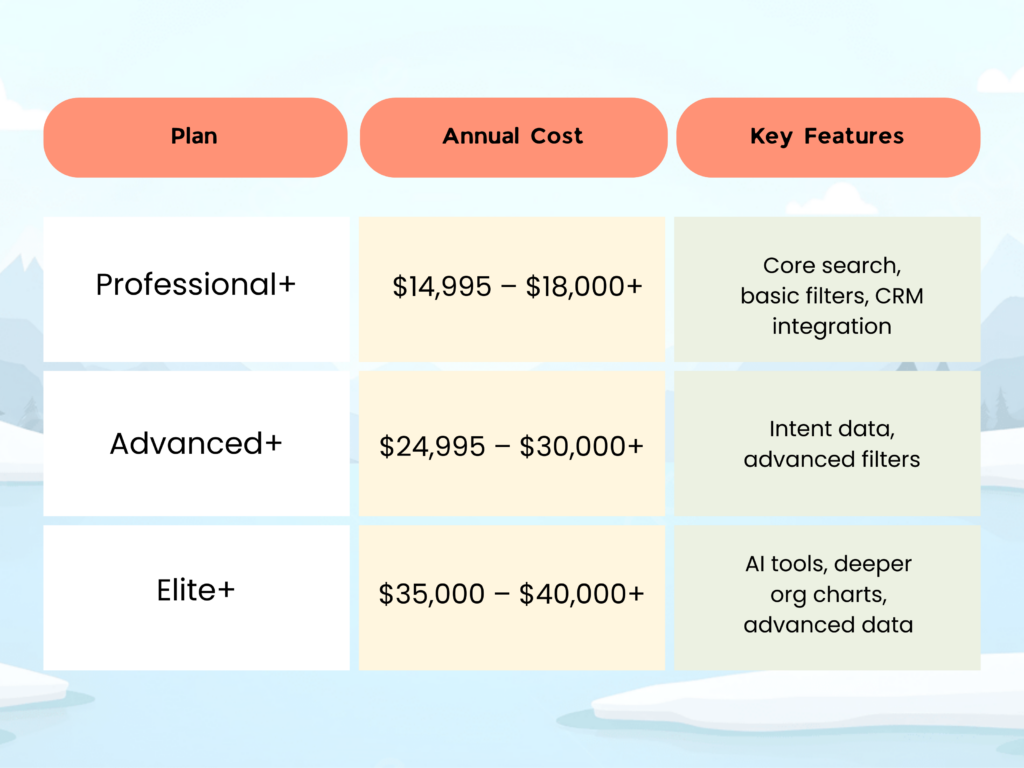
ZoomInfo pricing starts at roughly $15,000 per year and can climb past $40,000 depending on your plan tier, user count, and credit volume. That’s a significant investment for any sales or marketing team, and the lack of transparent pricing on ZoomInfo’s website makes budgeting even harder.
This guide breaks down each pricing tier, explains how the credit system works, covers hidden costs to watch for, and walks through negotiation tactics that can save you thousands at renewal.
How Much Does ZoomInfo Cost?
ZoomInfo pricing typically falls between $15,000 and $40,000+ per year. The exact number depends on which tier you select, how many users you add, and how many data export credits you require. Most contracts are annual, and the platform bundles user licenses with a set number of monthly credits for pulling contact information.
One thing worth knowing upfront: list prices are rarely final. Buyers regularly negotiate discounts of 30–65% off the initial quote, especially toward the end of a sales quarter.
Your actual cost will vary based on team size, credit volume, and any premium add-ons you include.
ZoomInfo Pricing Plans Explained
ZoomInfo organizes its pricing into three main tiers. Each tier unlocks progressively more features, though the jump in price between them can be significant.
ZoomInfo Professional Plus
Professional+ is the entry-level paid plan. It gives you access to ZoomInfo’s contact and company database, along with standard filters for narrowing down prospects by industry, company size, and job title. CRM integrations with Salesforce, HubSpot, and similar tools come included.
This tier works for smaller teams running straightforward outbound campaigns. That said, it lacks intent data and advanced filtering, which limits how precisely you can target accounts showing active buying signals.
ZoomInfo Advanced Plus
Advanced+ adds intent data to the mix. Intent data refers to signals indicating when a company is actively researching topics related to your product or service. With this information, you can prioritize outreach to accounts already in-market.
You also get more granular filtering options for building prospect lists. The trade-off is a higher annual cost, which may stretch the budget for mid-sized teams.
ZoomInfo Elite Plus
Elite+ is ZoomInfo’s enterprise-level offering. It includes AI-powered research tools, more detailed organizational charts, and expanded data enrichment capabilities.
Large sales organizations with dedicated RevOps support tend to get the most value here. For smaller teams, the premium price often exceeds what the additional features justify.
How ZoomInfo Credits Work
Credits are ZoomInfo’s internal currency. Every time you export a contact record, reveal a direct dial, or enrich existing data, you spend credits from your monthly allocation.
What ZoomInfo Credits Include
Your plan tier determines how many credits you receive each month. Here’s how credits typically get consumed:
Export credits: Spent when downloading contact records to your CRM or a spreadsheet
Bulk credits: Used for large-scale data pulls, often with volume restrictions
Monthly refresh: Credits reset at the start of each billing cycle based on your plan
Advanced and Elite plans generally include around 1,000 monthly credits per user. Professional plans offer smaller allocations.
Limitations of the Credit-Based Model
Running out of credits mid-month creates a real problem. You either wait until the next billing cycle or purchase additional credits at premium rates, sometimes 2–3x the per-credit cost in your base plan.
This unpredictability makes budgeting difficult, particularly for teams with fluctuating prospecting volumes. Unused credits don’t roll over either, so you lose what you don’t use each month.
Factors That Affect Your ZoomInfo Price
The base tier is just the starting point. Several variables influence your final contract value.
Number of User Licenses
Each additional seat adds to your annual cost, typically $1,500–$2,500 per user. Before signing, it’s worth auditing how many team members actually require full platform access versus limited or read-only functionality.
Credit Volume and Usage
Higher credit allocations mean higher costs. If your team consistently maxes out credits, you’ll face pressure to upgrade or purchase overages. On the flip side, paying for credits you don’t use wastes budget.
Premium Feature Add-Ons
Features like API access, advanced intent data, and global data coverage often carry separate charges. Add-ons can increase your total contract value by 20–40% beyond the base tier price.
Contract Length and Payment Terms
ZoomInfo requires annual contracts at minimum. Multi-year commitments can unlock additional discounts, though they reduce flexibility if your data requirements change. Unlike some competitors, ZoomInfo doesn’t offer pay-as-you-go or monthly billing.
ZoomInfo Add-Ons and Hidden Costs
The base subscription rarely reflects the full picture. Several add-ons can push your actual spend well beyond the initial quote.
ZoomInfo Copilot Pricing
Copilot is ZoomInfo’s AI assistant, designed to automate prospect research and surface relevant insights. It’s priced separately from core plans, adding another line item to your contract.
ZoomInfo API Pricing
API access lets you embed ZoomInfo data directly into your existing tech stack. Pricing varies based on call volume and use case, and it’s typically negotiated separately from your main subscription.
Intent Data and Enrichment Add-Ons
While Advanced+ includes basic intent data, premium intent signals and enhanced enrichment capabilities often require additional investment. Before signing, ask for a complete breakdown of what’s included versus what costs extra.
ZoomInfo Payment Terms and Contracts
ZoomInfo bills annually, not monthly. When people search for “ZoomInfo cost per month,” they’re usually dividing the annual price by 12 for comparison purposes. In practice, you’ll pay the full year upfront or in scheduled installments.
Contracts typically auto-renew, so mark your calendar 90 days before renewal to begin renegotiation — early negotiators achieve average savings of 49%. Missing this window often means accepting price increases without leverage.
Is ZoomInfo Worth the Price?
Value depends on your team’s size, budget, and specific data requirements. ZoomInfo delivers comprehensive North American B2B data, but the price point creates barriers for many organizations.
When ZoomInfo Makes Sense
Large enterprise sales teams with high-volume prospecting needs and dedicated budgets
Organizations prioritizing North American data where ZoomInfo’s coverage is strongest
Teams requiring deep CRM integrations and willing to invest in intent signals
When to Consider Alternatives
Budget-conscious teams that can’t justify $15,000+ annually
Startups and small businesses looking for flexible, scalable pricing
Organizations wanting pay-as-you-go options without long-term commitments
ZoomInfo: Pros and Cons
Pros
Comprehensive Features
Expansive Database
Frequent Updates
Extensive Integration Options
Direct Dials and Conversation Intelligence
Cons
Unclear Pricing
Premium Prices
Plans can be confusing
One- or two-year minimum contracts Only
Unfavorable for Small to Medium Business
While ZoomInfo has incredible features and a vast database, its prices can be a little too high for some businesses.
Compared to other competitors, ZoomInfo may fall short in terms of cost per lead and the number of features offered. In addition, you would have to go through the sales team for every small thing.
ZoomInfo Alternatives
If ZoomInfo’s pricing doesn’t fit your budget or workflow, several alternatives offer comparable data quality at different price points.
ReachStream
ReachStream provides access to 200M+ verified B2B contacts with 90% email deliverability and 95% data accuracy, without requiring annual contracts. The free IceBreaker plan includes 100 export credits monthly, so you can test data quality before committing any budget.
The platform also includes a Chrome extension for LinkedIn prospecting, API access for workflow automation, and real-time enrichment to keep your CRM current. Start with ReachStream’s free plan and see how verified data performs in your outreach.
Apollo combines sales engagement tools with B2B data in a single platform. Its freemium model makes it accessible for smaller teams, though data accuracy can vary depending on the segment you’re targeting.
Lusha
Lusha focuses on browser-based prospecting with pay-as-you-go credit options. It’s particularly popular among individual contributors who want flexibility without enterprise-level contracts.
Cognism
Cognism emphasizes European data coverage and GDPR compliance. For teams targeting international markets, it often provides better coverage than U.S.-centric platforms.
How to Negotiate ZoomInfo Pricing
ZoomInfo’s list prices are starting points, not final offers. Most buyers secure meaningful discounts through strategic negotiation.
1. Start Negotiations Early
Begin renewal discussions 60–90 days before your contract ends. End-of-quarter timing gives you additional leverage, as sales teams work to hit their targets.
2. Right-Size Your User and Credit Count
Audit actual usage before renewal. If you’re paying for 10 seats but only 6 people log in regularly, you have room to reduce costs without losing functionality.
3. Leverage Competitive Quotes
Obtain pricing from alternatives like ReachStream, Apollo, or Cognism. Documented competitive offers give you concrete leverage during negotiations.
4. Push for Multi-Year Discounts
Committing to two or three years often unlocks 15–25% additional savings. Weigh the discount against reduced flexibility if your data requirements shift.
5. Request Free Add-Ons or Credits
If the vendor won’t budge on price, ask for bonus credits, free training, or premium features at no extra cost. These concessions add value without changing the contract total.
A Smarter Way to Access B2B Data
ZoomInfo delivers solid data, but the pricing model creates challenges for teams that want flexibility and predictable costs. ReachStream offers an alternative path: 200M+ verified contacts, 90% deliverability, and 95% accuracy without the enterprise price tag.
Boost your sales pipeline with our powerful list builder.
Frequently Asked Questions
Does ZoomInfo offer a free trial?
ZoomInfo Lite provides limited free access without an annual commitment. Full-featured trials require contacting their sales team directly.
How much does ZoomInfo cost for a small team?
The minimum annual spend typically starts at the Professional tier, around $14,995+. This can be difficult for very small teams or individual users to justify.
What happens if I run out of ZoomInfo credits mid-contract?
You’ll either purchase additional credits at premium rates or wait for your next billing cycle refresh. Neither option is ideal for active prospecting.
Can I cancel my ZoomInfo subscription early?
Contracts are typically binding for the full term, with limited early cancellation options available.
How often does ZoomInfo raise prices at renewal?
Price increases at renewal are common Price increases at renewal are common, with SaaS pricing up 11.4% year-over-year. Proactive negotiation before auto-renewal is critical for cost control.
Is ZoomInfo pricing negotiable for startups?
Yes. Pricing is negotiable for all customers, and startups can leverage competitive alternatives and growth potential during negotiations.
Junaid Hussain KhanAuthor
Junaid Hussain Khan is the Business Development Manager at ReachStream, adept at forging strategic partnerships and identifying new market opportunities to propel ReachStream's growth and strengthen its position in the B2B ecosystem.