



> Operations
How to Evaluate B2B Data Vendors for Accuracy and Compliance

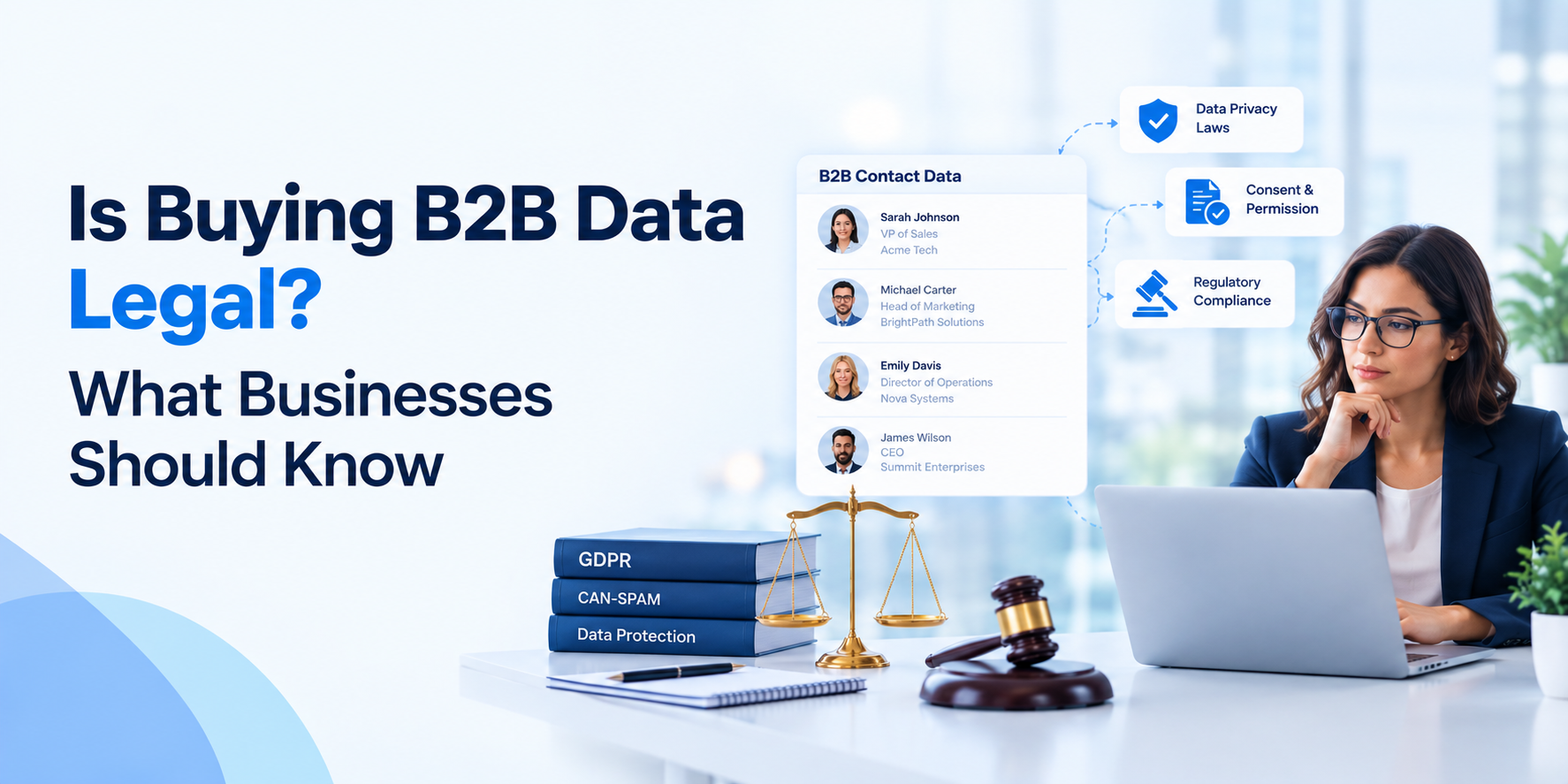
Is buying B2B data legal? Yes, buying B2B contact data is legal for US companies, including in 2026, as long as the data itself was collected lawfully and you use it in line with the CAN-SPAM Act. There is no US law that bans purchasing a B2B contact database outright. What is regulated is how the data was sourced and how you use it once you have it, not the act of buying it.
In the United States, the primary law governing B2B contact data and email outreach is the CAN-SPAM Act, enforced by the FTC. CAN-SPAM regulates commercial email broadly, it does not carve out a special exemption for B2B versus B2C messages, though enforcement in practice focuses heavily on deceptive and high-volume abuse.
Depending on your industry and who you’re contacting, other rules can layer on top: state-level data privacy laws for contacts in states like California, sector-specific rules for healthcare or financial contacts, and international frameworks like GDPR if you’re emailing contacts based in the EU. B2B contact data compliance means checking all of the layers that actually apply to your list, not just the federal baseline.
What makes collection legal isn’t a single certification, it’s source transparency. A compliant provider can explain where a given contact came from and under what basis they’re allowed to license it to you. A provider that can’t answer that question, or gives a vague answer like “our proprietary network,” is a signal worth taking seriously before you buy.
Before buying B2B contact data, check four things: how the provider sourced the data and whether they’ll document it, how recently the records were verified against live mail servers rather than static aggregation, whether the list has been resold to an unlimited number of other buyers in your space, and whether the provider supports basic compliance features like suppression lists and opt-out tracking.
A B2B contact database that fails on data freshness alone can create real risk even without a legal issue, high bounce rates from stale contacts damage your sending domain’s reputation and can look like spam behavior to mailbox providers, regardless of how the list was licensed.
Red flags run the other direction: a provider who can’t explain sourcing, a list with an unusually high bounce rate on delivery, no visible opt-out or suppression process, and pricing that seems too low for the volume claimed. Sales intelligence data is only as trustworthy as the process behind it, and a provider unwilling to explain that process is telling you something.
Search contact and company data with documented sourcing and real-time verification, built for teams that need to move fast without cutting compliance corners.
CAN-SPAM is the federal floor, but it isn’t the only law that can apply to a B2B contact list. If any contacts are based in the EU or EEA, GDPR applies regardless of where your company is located, and it requires either consent or a documented legitimate-interest basis before that first outreach email. If contacts are California residents, the CCPA and CPRA add data-subject rights around access and deletion.
Lawful data collection, in other words, isn’t a single checkbox, it’s a layered assessment based on who is on your list and where they’re located. A provider selling exclusively US business contacts under CAN-SPAM may not be equipped to help you stay compliant the moment your list includes EU-based decision-makers.
| Law | Applies to | Consent required | Key requirement | Penalty exposure |
|---|---|---|---|---|
|
CAN-SPAM (US) |
Applies to |
Consent required |
Key requirement |
Penalty exposure |
|
GDPR (EU) |
Applies to |
Consent required |
Key requirement |
Penalty exposure |
|
CCPA/CPRA (California) |
Applies to |
Consent required |
Key requirement |
Penalty exposure |
You carry primary compliance responsibility for every contact you email, regardless of where the data came from. Buying from a provider, even a reputable one, does not transfer that responsibility away from you. If a campaign violates CAN-SPAM, the FTC’s enforcement action is directed at the company that sent the email, not the data vendor that licensed the list.
That’s the practical reason data licensing and source transparency matter so much when choosing a provider. Data ownership of the contact list you purchase doesn’t include ownership of the compliance obligation, that stays with you for as long as you’re using the data to send commercial email.
ReachStream Prospect is built around exactly the compliance gap most B2B teams run into: contact data that’s sourced transparently and verified in real time, not aggregated once and left to decay. With 500M+ contacts, 50M+ companies, and 100M+ direct dials 35% connect rates, filterable by industry, and company size, teams can build campaign lists from data with a documented, licensable source.
Pull a sample of verified, source-transparent contacts and compare bounce rate and data freshness against your current list.
Is buying B2B data legal? Yes, for US companies, buying a B2B contact database is legal, CAN-SPAM regulates how you use the data, not whether you can purchase it. The real risk isn’t the purchase itself, it’s buying from a provider who can’t explain their sourcing, skipping suppression list management, or ignoring the additional rules that apply when contacts are based outside the US.
Treat data licensing the way you’d treat any vendor relationship with legal exposure attached: ask for source transparency, verify freshness, and remember that compliance responsibility stays with you regardless of where the list came from. Get those fundamentals right, and buying B2B contact data is a straightforward, low-risk way to build a compliant outbound program.
See how ReachStream Prospect combines verified data with the transparency your compliance process actually needs.
Check four things: documented data sourcing, real-time email verification rather than static aggregation, active suppression-list management, and whether the provider can explain the legal basis they’re relying on to license each contact to you.
A B2B data provider is compliant when they can document how each contact was sourced, verify emails against live mail servers, maintain suppression lists for opted-out contacts, and clearly state the legal basis for licensing that data to you. If a provider can’t answer those questions directly, treat that as a warning sign rather than a minor gap.
Legally, B2B contact data is collected either first-party, through a company’s own website forms, events, or product usage, or through aggregation of public and licensed business information into a searchable database. What makes the collection lawful is that the provider can document the source and the legal basis for using and licensing it, not any single certification or seal.
In the US, the primary law is the CAN-SPAM Act, which regulates commercial email regardless of whether the recipient’s data was purchased or collected first-party. Depending on your list, state laws like the CCPA and international frameworks like GDPR can also apply if contacts are located in those jurisdictions.
No. CAN-SPAM does not prohibit buying B2B email lists, and it does not require consent before you send a first email. It regulates how you send, accurate sender information, an honest subject line, a physical address, and a working opt-out, not whether the address was purchased.
Yes, buying B2B contact data is legal for US companies in 2026. No federal law prohibits purchasing a B2B contact database, and CAN-SPAM continues to regulate the conduct of sending rather than the act of buying. The main risk in 2026 is the same as in prior years: buying from a provider with poor sourcing transparency or skipping your own CAN-SPAM obligations once you have the data.
Author

Access 200M+ verified business emails and grow your sales pipeline effortlessly.
Don't forget to share this post!















Check out our other blogs!
How Marketing Agencies Use ReachStream to Serve More Clients
Is Buying B2B Data Legal? What You Need to Know
Intent Data: What It Is and How to Use It for Campaign Targeting
What Mid-Market SaaS Teams Need in Lead Gen Tools