

How to Evaluate B2B Data Vendors for Accuracy and Compliance
Your team bought a lead generation platform six months ago. Half your reps haven’t logged in since onboarding, and the other half complain the data bounces.
Platform adoption fails when data quality, integrations, or usability fall short—and fixing it requires understanding what these tools actually do, which features matter, and how to roll them out so reps use them daily. This guide covers how B2B lead generation platforms work, what to look for when evaluating options, and a step-by-step approach to driving adoption across enterprise sales teams.
B2B lead generation platforms provide verified contact data, buyer intent signals, and automated outreach to connect revenue teams with qualified prospects. Think of them as searchable databases of business contacts and companies, where you can filter by job title, industry, company size, revenue, and location to find the exact decision-makers you want to reach.
The market has split into a few distinct categories:
Each category serves a different part of the prospecting workflow. Some teams want everything in one place. Others prefer best-in-class tools for specific tasks. Knowing which category fits your workflow is the first step toward picking a platform your team will actually use.
The core workflow is pretty straightforward. You search a database using filters that match your ideal customer profile (ICP), verify the contact information, then export or sync directly to your CRM.
Enterprise teams, however, use these platforms differently than smaller organizations. You’re typically building larger lists, targeting multi-stakeholder buying committees, and managing more complex ICPs across regions or business units. That means you rely heavily on advanced filtering—firmographics like revenue and employee count, technographics like the software a company uses, and sometimes intent signals that indicate active buying behavior.
Once you’ve built a list, the platform verifies emails and phone numbers before export. This step protects your sender reputation and ensures reps spend time on contacts who can actually be reached. From there, validated data flows into your CRM or sales engagement tool, where it powers sequences, cadences, and personalized outreach.
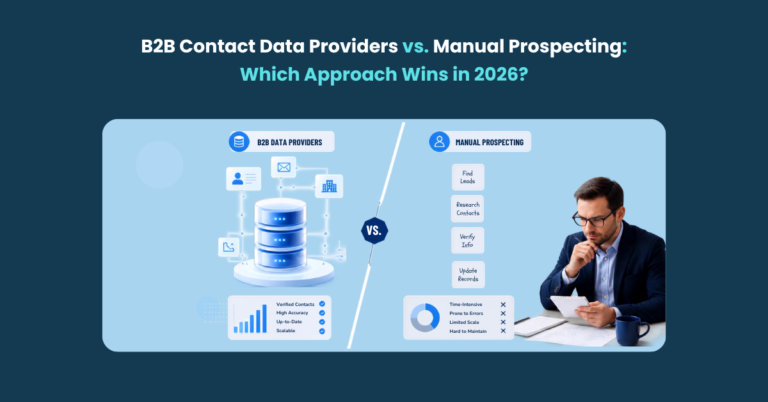
The most immediate benefit is time savings. Manual prospecting—searching LinkedIn, cross-referencing company websites, guessing at email formats—eats hours that could go toward actual conversations. A platform with millions of contacts and 20+ filters compresses that research into minutes.
Beyond speed, you get better lead quality. When you can filter by ICP attributes, reps focus on conversion-ready prospects instead of sifting through irrelevant contacts. That precision translates to higher response rates and more meetings booked.
Verified contact data also improves deliverability. Fewer bounced emails mean better sender reputation, which means your messages actually land in inboxes. Over time, this compounds into faster pipeline velocity and more predictable revenue.
The right B2B lead generation platform should do more than provide contact data, it should help sales teams identify, prioritize, and engage the right prospects with confidence.
Data accuracy is foundational. Without verified emails and direct dials, outreach fails before it starts. Look for platforms that describe their verification process—how often they refresh records, whether they use AI plus human review, and what accuracy rates they claim. ReachStream, for example, states 95% accuracy with a 7-step verification process.
The ability to filter by role, industry, company size, revenue, location, and technographics determines how precisely you can target. Platforms offering 20+ attributes let you build lists that match your exact ICP, so you’re not wasting outreach on contacts who were never going to convert anyway.
Static databases decay quickly. People change jobs, companies restructure, and contact information goes stale. Real-time verification before export ensures you’re working with current data, not contacts who left six months ago.
Your platform is only useful if data flows into your existing tools. Native integrations with Salesforce, HubSpot, and other CRMs eliminate manual imports. API access enables custom workflows and automation for teams with specific requirements.
Browser extensions that reveal verified contact details directly on LinkedIn profiles reduce friction in prospecting workflows. You can capture leads without leaving the page where you found them, then push that data straight into your CRM or sales sequence.
Data enrichment fills gaps in existing CRM records—missing phone numbers, outdated titles, incomplete company information. Platforms that refresh data regularly and track job changes keep your database current without manual effort. ReachStream refreshes 200M+ contacts every 45 days.
Enterprise sales teams don’t reject lead gen platforms because they dislike innovation, they reject tools that create more friction than value. Adoption depends on trust, workflow fit, and consistent results.
When reps experience high bounce rates or reach wrong numbers, they lose trust in the platform. That frustration leads to abandonment, even if the tool has strong features elsewhere. One bad experience can poison the well for months.
If the platform doesn’t sync with your existing tools, reps face manual data entry. That friction creates resistance—especially in enterprise environments where teams already juggle multiple systems. Nobody wants to copy-paste contacts between tabs.
Enterprise sales teams use a lot of software. Adding another complex platform creates cognitive load. If onboarding takes weeks and daily use feels cumbersome, adoption stalls. Simplicity matters more than feature count.
Platforms without robust filtering force reps to sift through irrelevant contacts. When the first few searches return poor results, reps conclude the tool isn’t worth their time. First impressions stick.

ReachStream combines 200M+ contacts with a simpler user experience, offering stated 95% accuracy and filtering by 20+ attributes. The platform includes a Chrome extension for LinkedIn prospecting, API access for workflow automation, and data enrichment that refreshes records every 45 days. Transparent pricing means you know what you’re paying before you commit.
ZoomInfo offers one of the largest B2B databases with deep company intelligence and intent data. Enterprise pricing and complexity make it better suited for organizations with dedicated RevOps resources to manage the platform.
Apollo provides contact data, email sequencing, and calling in a single interface. The freemium model makes it accessible, though feature breadth can create a steeper learning curve for new users.
Cognism excels in European data coverage and GDPR compliance, with strong mobile number accuracy. It’s particularly valuable for teams selling into EU markets where data privacy regulations are stricter.
Lusha focuses on quick contact reveals through its LinkedIn extension. The straightforward interface makes it easy to adopt, though data depth may be lighter than enterprise-focused alternatives.
Choosing the right B2B lead generation platform requires more than comparing feature lists. Enterprise teams need solutions that align with their workflows, compliance needs, and long-term growth goals.
Coverage without accuracy is meaningless. Ask vendors about their verification process, refresh frequency, and what accuracy rates they guarantee. A platform with 200M contacts at 95% accuracy outperforms one with 500M contacts at 70%.
Enterprise buyers face regulatory requirements—GDPR, CCPA, and industry-specific rules. Ensure your vendor maintains compliance certifications and can document their data sourcing practices.
Evaluate both native integrations and API flexibility. The platform fits into current workflows without requiring reps to change how they work. If it doesn’t connect to your CRM, adoption will suffer.
Hidden costs and opaque credit models create budget unpredictability. Look for clear pricing structures where you can estimate costs before committing. ReachStream offers transparent pricing so you know exactly what you’re getting.
Fixing adoption starts with understanding why sales teams stop using lead generation platforms in the first place. Most issues come down to workflow friction, poor data trust, or lack of clear day-to-day value.
Start by assessing your existing CRM data quality and prospecting processes. Identify gaps the platform will fill—this clarity helps you configure the tool for immediate value rather than abstract potential.
Configure filters and saved searches that match your ideal customer profile. When reps open the platform, they see relevant prospects immediately, not generic results that require more filtering.
Set up bidirectional sync so data flows automatically. Reps don’t switch contexts or manually import contacts—that friction kills adoption faster than almost anything else.
Provide hands-on training focused on specific workflows: building lists, verifying contacts, enriching records, exporting to sequences. Abstract feature tours don’t stick. Practical application does.
Use API or scheduled workflows to keep CRM records current and auto-generate lists based on ICP criteria. Automation reduces the manual work that makes platforms feel burdensome.
Track usage, export volume, and deliverability. Identify low adopters and address their specific blockers. Adoption is ongoing, not a one-time rollout.
Successful adoption shows up in measurable outcomes:
Adoption depends on three factors: data quality that builds rep trust, integrations that fit existing workflows, and simplicity that reduces friction. When those elements align, your lead generation platform becomes a daily habit rather than shelfware.
ReachStream is built for these outcomes—200M+ accurate contacts, 20+ filters for precise targeting, real-time verification, and seamless CRM sync. The result is a platform teams actually use, driving pipeline you can measure.
The best platform depends on your team’s specific needs. Prioritize verified contact data, ICP-based filtering, CRM integration, and transparent pricing. Platforms combining accuracy with workflow simplicity tend to drive the highest adoption rates.
Pricing varies from freemium tiers to enterprise contracts. Most platforms use credit-based or seat-based models, so evaluate total cost against expected usage and data quality guarantees before committing.
The most effective approach combines a reliable data platform for outbound prospecting with inbound marketing and intent signals. This multi-channel approach lets you reach decision-makers through email, phone, and social simultaneously.
Most teams see initial results within the first few weeks if the platform integrates with existing workflows. Full adoption and measurable pipeline impact typically take one to three months as reps build the tool into their daily routines.
Marketing professional with a Master’s degree in Marketing, specializing in SEO, content strategy, social media, performance marketing, prospecting, and demand generation.
Access 200M+ verified business emails and grow your sales pipeline effortlessly.
Don't forget to share this post!















Check out our other blogs!
ReachStream Prospect vs. Prospeo: Which Delivers More Accurate Data
B2B Data Enrichment: Complete Guide to Enriching Lead Data
The Complete Guide to B2B Data Verification in 2026
ReachStream Prospect Reviews in 2026: What Real Users Say on G2