


Sales prospecting techniques are the specific methods a sales team uses to identify, research, and reach out to potential buyers before they enter a formal deal cycle. In 2026, the techniques that actually fill a pipeline combine three things: signal-based targeting instead of blind lists, AI-driven personalization at scale, and coordinated outreach across email, phone, and LinkedIn rather than a single channel. Reps who treat prospecting as a repeatable system, not a daily scramble, are the ones who consistently build a full pipeline.
At its simplest, sales prospecting is the first stage of the B2B sales process: identifying accounts that fit an ideal customer profile (ICP), qualifying them against real buying signals, and starting a conversation before a formal RFP or demo request ever lands in an inbox. Modern sales prospecting techniques lean on data. Job changes, funding rounds, headcount growth, and new technology adoption all serve as buying signals that a rep, or an AI-assisted tool, can flag long before a prospect fills out a contact form.
This guide walks through what modern B2B sales prospecting techniques look like in 2026, how they compare across channels, and the exact steps, mistakes, and best practices that help you fill your sales pipeline instead of just adding names to it.
Before you build a cadence, write down the three buying signals that most often precede a deal for your best customers, for example a recent funding round, a new VP hire, or a specific job posting. Every prospecting technique below works better once you know what to look for.
Not every outbound prospecting method performs the same way anymore. Buyers now complete roughly 61% of their purchase journey before ever talking to a rep, and 80% of sales professionals say prospecting is the hardest part of their job.
The sales prospecting strategies 2026 teams rely on share four traits in common: they use real signals instead of static lists, they reach buyers across more than one channel, they personalize at scale instead of by hand, and they engage more than one stakeholder in the buying group, since the average B2B deal now involves around 22 people. Put together, these are the modern sales prospecting tactics that separate a full calendar from an empty one.
Signal-based prospecting means targeting accounts that are already showing intent: a recent executive hire, a funding round, a job posting for a role your product supports, or a spike in relevant search activity.
Instead of dialing down a static list in order, reps prioritize accounts showing real signals of readiness, often flagged by modern sales intelligence tools that monitor this activity automatically. This is one of the clearest shifts in outbound prospecting methods over the last two years, and it is a big part of why some reps now get meetings from a fraction of the volume that used to be required.
Single-channel outreach is losing ground. Coordinated, multi-channel outreach across email, phone, and LinkedIn can lift response rates by roughly 287% compared with email alone, and over 80% of B2B leads sourced from social platforms come through LinkedIn specifically. A typical omnichannel sales prospecting sequence runs five to eight touches over two to three weeks: an opening email, a LinkedIn connection request with a short note, a follow-up call, a value-add email, and a final check-in. Most sales need five or more follow-ups to get a response, yet close to 44% of reps give up after just one attempt.
AI-driven sales prospecting tools can research a prospect’s recent news, role, and company context in seconds, then draft a first-pass message a rep edits for tone and accuracy, the foundation of personalized sales cadences that do not feel mass-produced. Sales professionals who use AI in their prospecting workflow are about 3.7 times more likely to hit quota, and top-performing teams running high-velocity sales prospecting typically use close to three times more sales technology than teams that miss targets. The key word here is assisted. Automated sales outreach tools can shrink the research and drafting time (reps spend an average of over 13 hours a week just researching prospects), but a rep should still review every message before it sends, since personalization only works when it reads like it came from a person who actually looked at the account.
Multi-threading means reaching more than one stakeholder inside a target account at the same time, rather than waiting on a single champion to respond. With an average B2B buying group now around 22 people, single-threaded outreach is a slow way to build a deal. Predictive sales prospecting adds a second layer on top: scoring accounts and contacts by how likely they are to convert, based on firmographic fit, engagement history, and intent signals, so reps spend their limited outreach time on the accounts most likely to reply. This is where predictive sales analytics earn their keep, turning a flat list into a ranked one.
Buyer research has shifted heavily toward self-directed evaluation before a sales conversation ever starts. That is exactly why front-loaded, buyer-centric prospecting outperforms generic cold outreach: by the time a buyer is ready to talk, they have often already ruled out a few options on their own.
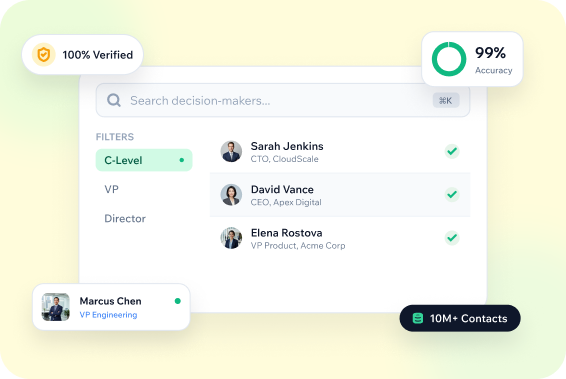
ReachStream Prospect is designed to help sales and marketing teams search verified B2B contact and company data with filters built around how sales prospecting actually works today: by role, industry, technology, and company size.
There is no single best channel for every team, but the data does point to some clear differences in effort, speed, and scale. The comparison below can help you decide where to invest first, and where a hybrid approach, using more than one method, makes sense.
| Channel | Best For | Avg. Reply / Connect Rate | Touches Needed | Scalability |
|---|---|---|---|---|
|
Cold Email |
High-volume outbound prospecting methods |
~3.4% average reply rate (10%+ for top performers) |
4 to 7 emails over 1 to 2 weeks |
High, scales to thousands of contacts |
|
Cold Calling |
Narrow, high-value target accounts |
~16.6% connect rate, 2 to 3% dial-to-meeting rate |
3+ dials on average to connect |
Medium, limited by rep hours |
|
LinkedIn / Social Selling |
Warming up a contact before a call or email |
~10.3% response rate on direct messages |
1 connection request plus 2 to 3 follow-ups |
Medium, works best for named accounts |
|
Omnichannel (Email + Phone + LinkedIn) |
Most teams running structured sales prospecting techniques |
Up to 2 to 3x higher than single-channel |
5 to 8 touches over 2 to 3 weeks |
High, the standard for most modern teams |
Run a small test batch of 25 to 50 accounts through a new sequence before rolling it out to your full list. It is the fastest way to catch a weak subject line or a broken personalization token before it costs you a few hundred touches.
A few habits separate the teams that consistently fill their sales pipeline from the ones stuck refreshing their CRM every morning. Send email in the Tuesday to Thursday, 8 to 10 a.m. or 3 to 4 p.m. windows, when open rates tend to run highest. Keep sequences to 4 to 7 touches rather than dragging out a dozen follow-ups that start to read as spam. Treat your CRM as the single source of truth for every touch, so sales and marketing alignment does not fall apart the moment a lead changes hands. And revisit your ICP every quarter, since the accounts that converted last year are not always the ones showing intent this year.
Before you scale any sales prospecting technique across your whole list, ask what percentage of your contact data has been verified in the last 90 days. A high-volume cadence built on outdated emails and phone numbers will always underperform, no matter how good the messaging is.
Sales prospecting techniques sit at the very top of the lead generation funnel, before qualification, before a demo, before a proposal, and they are really revenue growth strategies in disguise. Get this stage wrong and every later stage inherits the problem: a slow pipeline, a low SQL rate, and a sales team spending more time researching than actually selling. ReachStream Prospect is built to support this stage specifically. It can help sales and marketing teams search verified B2B contact and company data, apply the same filters that support signal-based and ICP-driven prospecting, and rely on straightforward CRM integration so the handoff between marketing and sales stays clean instead of becoming a bottleneck.
Pull a real sample of verified contacts and compare it against the list you are already working from. A free plan is a reasonable way to see the data quality difference before committing to a paid subscription.
The sales prospecting techniques that fill a pipeline in 2026 are not a single trick. They are a system: a documented ICP, signals worth acting on, a cadence that spans more than one channel, AI used to assist rather than replace judgment, and a CRM that keeps the whole process honest. Teams that treat prospecting this way consistently outperform the ones still running a single cold email sequence and hoping for the best.
See how ReachStream Prospect combines verified search filters, real-time email verification, and signal-based data to support the sales prospecting techniques covered in this guide.
Sales prospecting techniques are the specific methods a sales team uses to find, research, and start conversations with potential buyers before a formal deal process begins. In 2026 the most effective techniques combine signal-based targeting, omnichannel outreach across email, phone, and LinkedIn, and AI-assisted personalization at scale.
Most B2B teams get the best results from 2 to 3 channels used together rather than relying on a single method. A typical omnichannel sequence pairs email with phone calls and LinkedIn messages across 5 to 8 touches over two to three weeks.
Average cold email reply rates sit around 3.4%, though top-performing campaigns reach 10% or higher, mainly through stronger targeting and personalization. Highly personalized campaigns can outperform generic outreach by more than 100%.
Research shows roughly 80% of sales require five or more follow-up touches before a prospect responds, yet close to 44% of reps stop after just one attempt. Building a documented cadence of at least 4 to 7 touches closes most of that gap.
Signal-based prospecting means targeting accounts that show real indicators of buying readiness, such as a recent funding round, a new executive hire, a relevant job posting, or growing headcount, instead of working through a static list in order.
Yes, when it is used to assist rather than replace a rep. Sales professionals using AI tools in their prospecting workflow are roughly 3.7 times more likely to hit quota, mainly because AI cuts down research and drafting time that would otherwise eat into selling time.
Multi-threading means reaching more than one stakeholder inside a target account at the same time rather than depending on a single contact to respond and move the deal forward. It matters more now that the average B2B buying group includes around 22 people.
ReachStream Prospect is designed to help sales and marketing teams search verified B2B contact and company data using filters built around industry, technology, company size, and seniority, so the account and contact research stage of prospecting takes less manual work.
The most common mistake is stopping after a single touch or treating every account with the same generic cadence. Following up at least five times and adjusting the channel mix based on account size and ICP fit both measurably improve results.

Author

Access 200M+ verified business emails and grow your sales pipeline effortlessly.
Don't forget to share this post!















Check out our other blogs!

How to Build an Interior Designer Contact List for B2B Sales
How to Build a Targeted Hospital CFO Contact Data List

How Email Verification Improves Email Deliverability